Tag Archive for: Region 9A

NEW YORK CITY – Full time, non-tenure track faculty at New York University have voted by an overwhelming margin (553 to 72, or 89.5%) in favor of joining Contract Faculty United – UAW (CFU-UAW), according to ballots tallied Wednesday night by the American Arbitration Association. CFU-UAW will represent nearly 1,000 Contract Faculty across NYU. 

“With participation from nearly 67% of the unit, this is a resounding vote for our union,” said Ahmed Ansari, Industry Assistant Professor in Technology, Culture and Society at Tandon School of Engineering. “Our work powers NYU’s educational mission—but too many of us face unpredictable salaries that routinely shortchange women and people of color. We look forward to negotiating a strong first contract that allows us to live in New York City, protects our job security and academic freedom, and makes NYU an equitable place to work. Our working conditions are our students’ learning conditions, and we are excited to bargain as equals with the university administration to make progress on these issues and more.”

“UAW workers in higher education are standing up and winning major improvements all across the United States, raising the standards for all academic workers,” said UAW President Shawn Fain. ”We applaud NYU contract faculty for taking this major step towards winning the pay, benefits and respect they deserve, and we’ve got their back.”

“We are excited to welcome NYU contract faculty into the growing UAW family,” said Brandon Mancilla, Director of UAW Region 9A, which includes New York City, New England and Puerto Rico.  “After a long fight and a historic election victory, contract faculty can now look forward to bargaining a strong first union contract.”

NYU Contract Faculty join more than 100,000 academic workers across the United States who are represented by the UAW. In the last five years alone over 40,000 academic workers around the country have chosen to become part of the UAW, including nearly 15,000 from the east coast area.

Learn more at NYUContractFacultyUnion.org

On December 22, 2023, forty-nine workers at EmPower-Solar in Bethpage, NY, voted overwhelmingly to join UAW Local 259. The organizing victory was achieved despite the company hiring lawyers and lobbyists in attempt to thwart workers’ efforts to unionize.

Instead of respecting its workers’ decision, EmPower continues to union-bust. On December 29, the company unilaterally laid off forty percent of its workforce without even notifying the union of its decision.

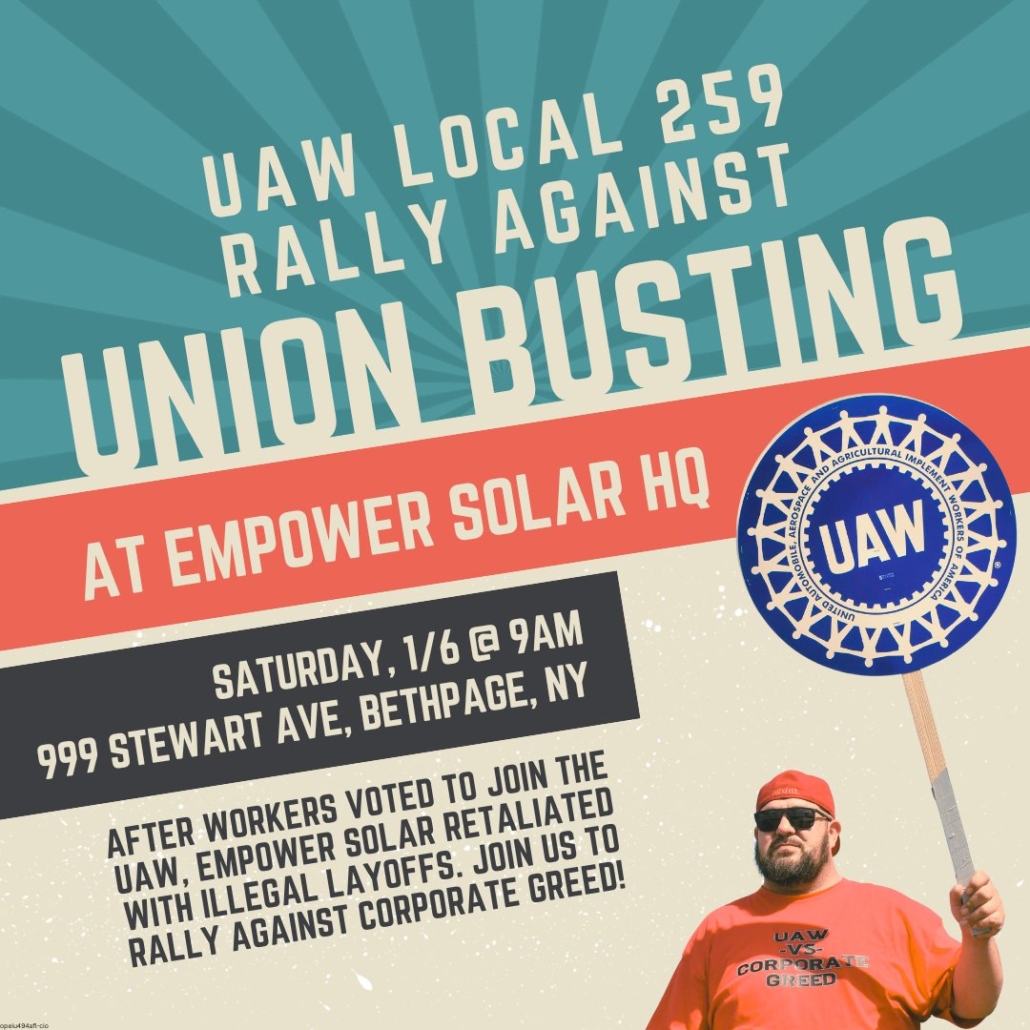
In response to the company’s despicable union-busting actions, Local 259 is holding a rally on Saturday, January 6, at 9 am ET at EmPower’s Headquarters in Bethpage, NY.

“Working in renewables could be a great job, but the industry needs a healthier balance of power between management and labor to make growth sustainable,” EmPower-Solar worker Daniel Lozano and Local 259 Vice President Michael DiGiuseppe wrote in an op-ed last month. “These are the jobs of the future. They ought to pay a living wage, be safe, and be unionized.”

If you are in the New York area this Saturday, join Local 259 and send a message to EmPower that union-busting is unacceptable.

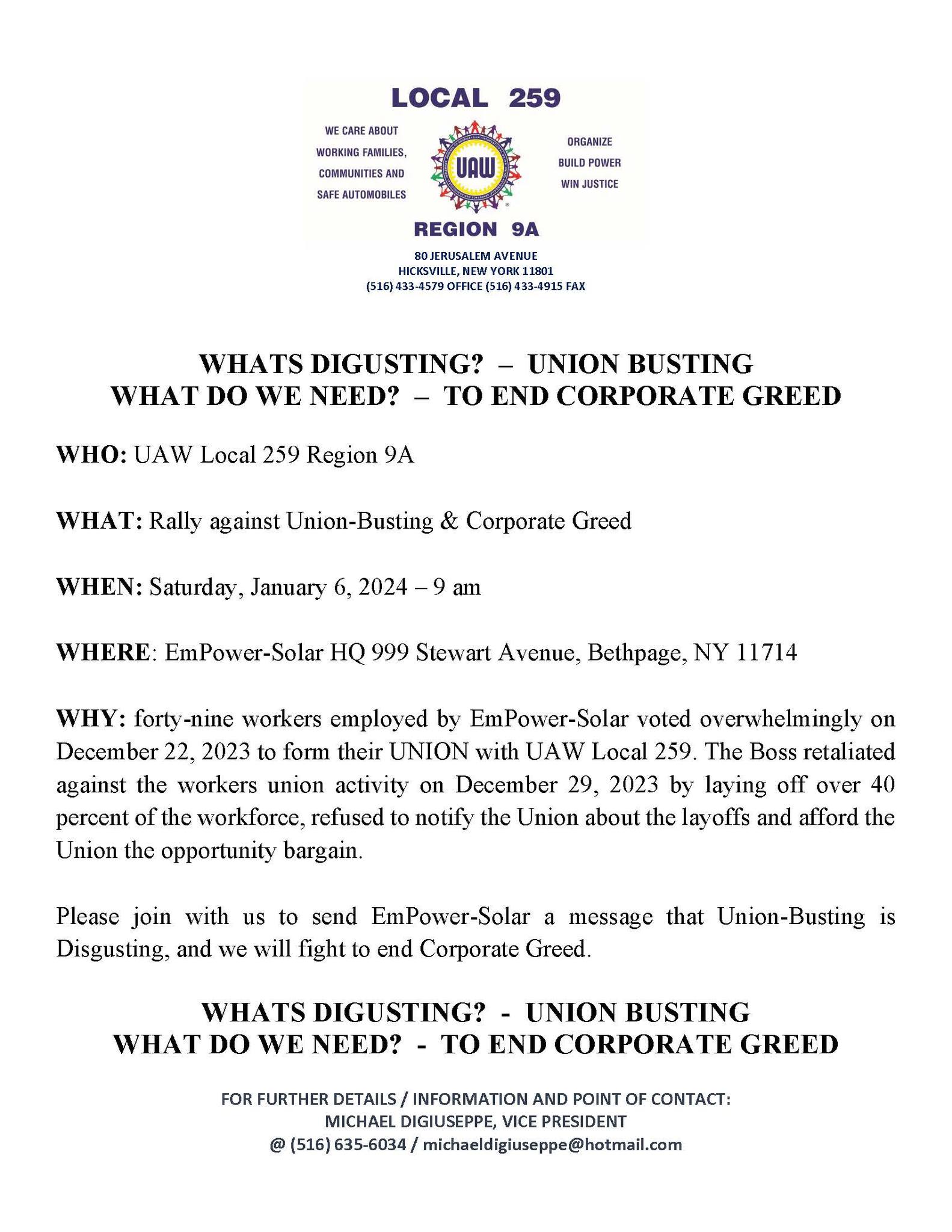
WHO: UAW Local 259, Region 9A

WHAT: Rally Against Union-Busting and Corporate Greed

WHEN: Saturday, January 6, 2024 – 9 am ET

WHERE: EmPower-Solar HQ 999 Stewart Avenue, Bethpage, NY 11714

Postdocs who work at the Icahn School of Medicine at Mount Sinai in New York voted to ratify their first-ever collective bargaining agreement by 98%, the SPOC-UAW Bargaining Committee announced on Friday, December 22.

390 members voted yes on the contract, with eight members voting no.

“Thank you to everyone who participated in the vote,” the Bargaining Committee posted on the SPOC-UAW website Friday evening. “After years of organizing and 15 months of bargaining, this vote is a strong mandate for researchers to continue improving our working conditions and the research conditions at Sinai.”

Workers were able to secure substantial gains in the new contract after a 12-day strike, including the highest minimum salaries for postdocs in the country, protections against harassment and bullying, guaranteed housing for three years, and six weeks of maternity leave.

“We will soon announce a meeting to start formally establishing our union here at Mount Sinai, including next steps like enforcing our contract improvements, discussing and deciding on Local Union affiliation, electing officers, and planning ongoing organizing efforts,” the Bargaining Committee wrote on the unit’s website.

The Bargaining Committee reached a tentative agreement with the school on Monday, December 18.

In June of 2022, nearly 90% of workers voted to choose Sinai Postdoctoral Organizing Committee-United Auto Workers (SPOC-UAW) as their union and bargaining representative.

Postdocs perform a wide range of critical research, from developing new therapies to fight disease to advancing new technologies that will shape the future of research, and much more.

Postdoctoral Researchers at the Icahn School of Medicine at Mount Sinai in New York reached a tentative agreement with the administration on Monday, December 18.

“We are very proud to have won many substantive and important improvements in every major area we set as a priority,” the Sinai Postdoctoral Organizing Committee (SPOC-UAW) Bargaining Commitee wrote on the unit’s website after the agreement was reached. “These gains are the direct result of tireless organizing, nearly 16 months of bargaining, and our powerful historic strike. Together, we fought, and we won.”

The Bargaining Committee will conduct a straw poll to gain feedback from members before deciding whether workers should continue or pause the strike while voting on the tentative agreement takes place.

Workers at the institution walked out on an unfair labor practice strike on December 6, after attempts to reach a deal with Mount Sinai administrators were unsuccessful.

“We love our research, but Sinai is leaving us no choice,” said Andrea Joseph, a postdoctoral fellow in the Department of Obstetrics, Gynecology, and Reproductive Sciences, when the strike began. “Our priority has always been ensuring that science at Mount Sinai is sustainable and inclusive, and that means fair pay and housing and parental benefits that allow all of us to take care of our families and stay in the careers we love in New York City.”

In June of 2022, nearly 90% of workers voted to choose Sinai Postdoctoral Organizing Committee-United Auto Workers (SPOC-UAW) as their union and bargaining representative.

Postdocs perform a wide range of critical research, from developing new therapies to fight disease to advancing new technologies that will shape the future of research, and much more.

The COP28 climate summit recognized we are at “the beginning of the end” of the fossil fuel era and need to speed up transition to renewable energy. But union-busting by renewables companies, including the top solar provider on Long Island, threatens to slow it down.

Renewables are big business in the US, stoked by many tens of billions in federal funding. But insiders know that renewables companies are often chaotic, with underpaid, demoralized workers, unsustainably high turnover, and difficult, dangerous working conditions. Solar installers’ median income is just under $45,00040% less than fossil fuel workers. Getting off fossil fuel will require fixing the renewables industry’s labor problems, which requires unions.

Historically, organized labor grew up with fossil fuel industries. At their peak, unions represented 60% of autoworkers. Today it’s about 16%, and 17% across the fossil fuel sector. But only 4% US solar workers and 6% of wind power workers are in unions, reflecting how fiercely renewables companies oppose them.

Big federal subsidies and tax credits compound the problem. Renewables companies are exempt from prevailing wage and other labor requirements under the Inflation Reduction Act (IRA) if they stay below utility scale (25 megawatts a year). So, the more they cut costs and squeeze workers, the more of the IRA money they can pocket, and the easier it is to spend money on union-busting. That is a perverse incentive effectively diverting public resources to private gain while hurting workers and limiting how fast renewables grow.

EmPower Solar, a Bethpage, NY-based solar company serving Long Island, is a case in point. Rather than pay its workers fairly, it pays lawyers and lobbyists to prevent them from organizing. It hired the Cincinnatti-based lobbying firm National Labor Relations Advocates, which advertises a 90% success rate at helping clients “avoid any threat of a union coming into your business,” and charges hefty fees for the service.

EmPower faces unionization because of its labor practices. It pays installers low base wages plus an untransparent per-panel bonus. Typical monthly take-home pay might be around $2500 plus a $1200 bonus, but the bonus is unreliable. It falls in slower seasons and can be heavily docked for such things as breaking a lamp. There are cases where the bonus suddenly tanked, and installers had to rely on friends and family for rent and food. Some skipped meals and lost weight. Many installers are in debt because the job does not pay enough to live on.

EmPower foremen are paid little better than installers, and often take second jobs like driving for Uber. While they worry about their crews’ safety on rooftops around high voltage equipment, they also worry about making their car payment. When accidents happen, foremen are scapegoated and penalized with demotion and pay cuts, as if it is their supervision at fault rather than unsafe company practices.

Quick to cut pay, EmPower is slow to raise it. It lacks a clear, accountable compensation structure, delays performance reviews, and has high turnover, so workers who keep their jobs often stay stuck at or near entry-level pay. It is also slow to reimburse their outlays for driving to jobsites.

EmPower hires workers for the peak summer season, then fires them, often after a month, and in some cases as little as two weeks. Workers are so stressed and insecure about getting laid off that they are afraid to take lunchbreaks or refuse dangerous jobs they should not accept. When they brought their concerns to management, they got canned talk-points from its union-busting lawyers instead of action.

Finally, after watching Shawn Fain and the UAW stand up and get results for auto workers, EmPower workers reached out to the UAW Local 259, which agreed to represent them. It filed a notice of election with the National Labor Relations Board last month. EmPower workers vote on unionizing this Friday.

Since the filing, the company changed tactics. It said it cared about worker concerns, the layoffs stopped, the compensation problems improved a little. But this only happened once the workers got organized. It seems tactical, designed to peel off support to swing the vote against a union.

Another tactic is EmPower’s false claim the UAW is a “bad fit” because its workers do not build cars. But the truth is, the company would fight any union. The UAW had famous successes at Big Three car companies, but it is a fallacy to pigeonhole unions in the old manufacturing, fossil-fuel based economy. They are more relevant and needed than ever for the high-tech economy and renewables ramp-up. Today’s UAW represents technicians, National Institutes of Health scientists, defense workers, office workers, environmental workers, and more. It can and should do for renewables workers what it did for autoworkers.

Working in renewables could be a great job, but the industry needs a healthier balance of power between management and labor to make growth sustainable. These are the jobs of the future. They ought to pay a living wage, be safe, and be unionized.

In solidarity,

Daniel Lozano, Installer, EmPower Solar

Michael DiGiuseppe, Vice President, Local 259

New York City – On Thursday August 3rd, members of the Legal Aid Society chapter of the Association of Legal Aid Attorneys (UAW Local 2325) held an informational lunchtime picket across all five boroughs of New York City. The picket was organized by the chapter’s Contract Action Team (CAT).

Legal Aid Society ALAA members took to the picket line to voice their frustrations over bargaining and record attrition of their members. An unprecedented number of attorneys have left the Legal Aid Society in recent years due to stagnant wages, inflation, student debt, and rising cost of living.

All the while, Management has failed to recruit new staff. Those members who remain are facing crushing caseloads as they struggle to provide world-class legal representation to the most vulnerable New Yorkers in criminal, family, housing, and immigration courts.

“We’re really fighting for basic human dignity, a fair wage, autonomy to do our job,” said Olga Karounos, a criminal defense attorney at Legal Aid. “We’re not just fighting for our lawyers, but for our clients themselves.”

The chapter has been bargaining with management since September 2022 and is still without a contract. Management has failed to come to the union with any substantive economic offer to meet the union’s primary demand of significant base salary increases. In addition to fighting for salaries, LAS chapter members are advocating for reasonable caseload caps for our members representing clients in Housing Court and for flexible working conditions.

“This can’t be tolerated – it’s an untenable and unsustainable position for all the attorneys,” said Atusa Mozaffari, a housing attorney with the Legal Aid Society. “Hopefully, as contract negotiations continue, our voices will be heard, and we’ll get the things we deserve.”

UAW WELCOMES BROOKLYN ACADEMY OF MUSIC EMPLOYEES

UAW ADDS OVER 14,000 NEW MEMBERS SINCE AUGUST 2018

Eighty-two percent of workers at the Brooklyn Academy of Music voted to join the UAW last week joining UAW Local 2110.

The administrative and cinema workers will now be able to bargain following reductions in benefits such as health care and 401(k) matching, and conversion of full-time jobs to part-time jobs among other issues. The 145 employees petitioned for an election in April.

“We are here because we believe in BAM’s mission,” Jesse Trussell, a film programmer who helped organize at BAM, said on Twitter when petitions were filed. “Our union will make BAM stronger, more democratic and more sustainable.”

Trussell said that BAM administrative staff needs a “powerful voice” and said workers were inspired by similar successful campaigns at the Tenement Museum and the New Museum.

The Workers Defense League in New York recently honored UAW Local 2110 Maida Rosenstein during the group’s 81st anniversary dinner May 16. Rosenstein has always given priority to organizing new workers. She has been involved in graduate worker campaigns at New York University and Columbia, at a host of nonprofits and museums, and in higher education. For more than 30 years, she has strongly promoted membership-led, grassroots union activity, in contract negotiations campaigns, new organizing and political action. As a result, Local 2110 has developed a broad group of leaders, and a degree of mobilization and activity that stands out within the labor movement.

Rosenstein’s first successful strike was in high school when she led a “pants strike” to force the school to allow girls to wear pants. She and her classmates were reprimanded and sent home, but a week later the rules were changed and girls were allowed to wear pants to school. The strike taught her that collective action was a potent weapon in promoting women’s rights.

After receiving a degree in art from Rutgers University, she became a university clerical worker, and in 1981 she joined District 65 UAW’s organizing committee at Columbia University. The goal was to organize 1,100 clerical workers, and the campaign, which brought together her feminist views and her commitment to workers’ rights, was a tough one. There were years of legal delays and a vicious anti- union campaign in which the university claimed that the union would interfere with the highly personal relationship between a secretary and her boss. She learned the basics of organizing and the drive was transformative for her. After the union won the election in 1983, she became a fulltime organizer and ultimately was elected as vice president and then president of UAW Local 2110 (the successor to the District 65 Technical, Office and Professional Division).

Rosenstein serves as the vice chair of the UAW New York State Political Action Council and is chair of the UAW International Advisory Council on Technical, Office and Professional Workers. She is also elected to the New York State Committee of the Working Families Party.

Other honorees included Robert Martinez Jr., president of the International Association of Machinists and Aerospace Workers and James Slevin, president of Local 1-2, Utility Workers Union of America.

UAW-NYU Graduate Employees Approve Only Contract Covering Private Sector Graduate Employees

The United Auto Workers announced today the ratification of the contract with New York University which covers over 1200 graduate employees, members of the Graduate Student Organizing Committee-UAW Local 2110, who perform various functions for the university including teaching and research.  Once again, this makes NYU the only private university in the country with a unionized graduate employee workforce.  The agreement was ratified by 99% of the membership, with nearly 1,000 members voting.

“This contract is a major step forward for our members,” said Julie Kushner, Director of UAW Region 9A.  “They did not back down after being stripped of their bargaining rights in 2005.Their commitment to justice will have a huge impact on  the working lives of teaching and research  assistants throughout the university. This victory has already inspired other private sector graduate employees to organize.”

The agreement made substantial gains in wages, health care, including a 90% subsidy towards individual coverage and first time support for dependent coverage, childcare benefits and tuition waivers.  In addition, it doubles the starting wage to $20 per hour over the life of the five-year agreement for workers at NYU’s Polytechnic School of Engineering, who perform and support cutting edge research. (Greater detail is appended below.)

“This contract will make a real difference in our lives here at NYU and will raise the bar for private sector graduate working people nationally,” said Lily Defriend, a Ph.D. candidate in the Anthropology Department. “Right here in New York City our campaign and this contract win have contributed to graduate employees at Columbia and The New School organizing at the UAW.”

After being the first group of private university graduate workers to successfully unionize in 2000, the UAW won a groundbreaking contract at NYU.  In 2005 the university withdrew recognition, hiding behind a Bush-era NLRB decision stripping graduate employees of the right to collective bargaining.  Undeterred, the workers at NYU fought an eight-year battle for recognition and the university agreed to recognize the UAW once again subject to an election, in which they remained neutral, conducted by the American Arbitration Association.  The workers voted 98.4% in favor of being represented by the UAW in December 2013.

The UAW represents more than 45,000 academic workers across the U.S., including graduate employees at the University of Massachusetts, University of Connecticut, University of Washington, University of California and California State University.