Dear Higher Education Family,
We are excited to share our first Higher Education Department Newsletter, which is a summary of 2025. We close out this year with a number of big wins and fights back, in a year of unprecedented attacks from an increasingly authoritarian presidency. The highlights below are the results of the hard work of members and elected leaders across the UAW.
Moving forward, we hope these newsletters will be a source of information about the happenings across the country, as we are often isolated in our own locals or regions. Please feel free to reach out to the department (highered@uaw.net) if there are topics or events you would like to see highlighted.
Higher Education Council
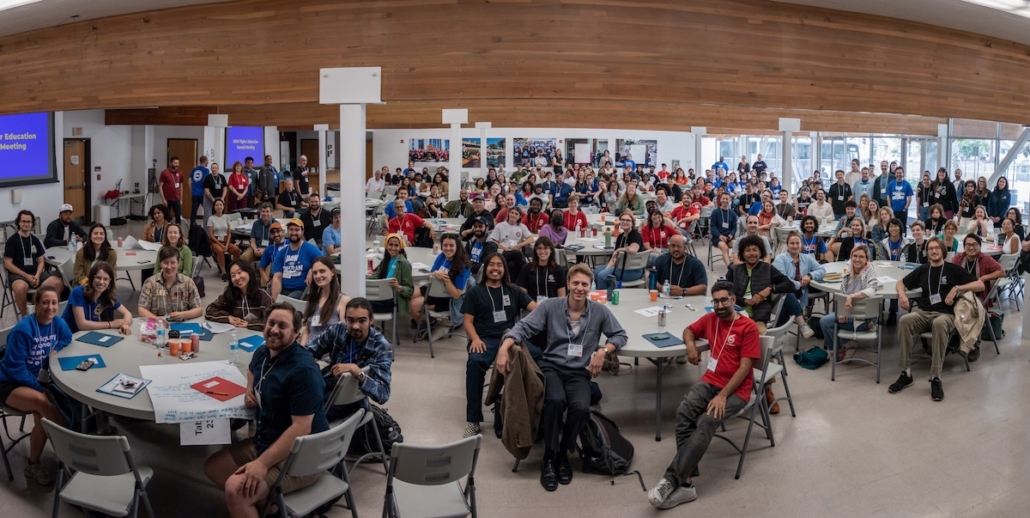
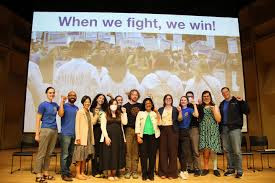
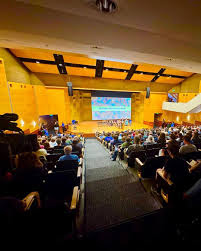
In a milestone for Higher Ed organizing in the UAW, in June 2025, we held the first Higher Education Council meeting in Pico Rivera, California. In addition to the 63 democratically elected delegates, the Council meeting was attended by President Fain, Vice President Dickerson (1A), Miller (6) and Mancilla (9A), Assistant Director Jensen (9), 33 workers from first contract campaigns, and over 150 members. Delegates approved Council bylaws and elected Council Officers: Secretary Iris Rosenblum-Sellers from Local 4811 and Alternate Secretary Lenny Black from Local 7902. Members discussed ways to build political power to defend higher education against ongoing attacks by the Trump administration– from attacks on university funding to attacks on international workers. Members also discussed building union density and began initial discussions for winning strong industry standards across higher ed. Following a day and a half of workshops and productive conversations, we closed out the second day by meeting in sub-councils: faculty, student workers, staff, and postdocs and researchers. The sub-councils will continue to meet periodically, and the full council will plan to hold the 2026 meeting over zoom.
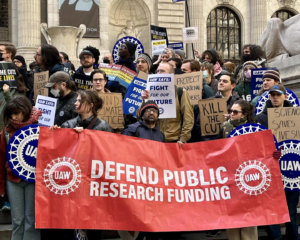
Upon taking office on January 20th, Trump enacted a number of attacks on higher education, targeting federal funding to universities and scientific research as a means to restrict free speech and academic freedom. He attempted to reduce indirect costs in grants, which go toward maintaining labs and covering the cost of administrative and maintenance staff, including some of our members. The administration cut federal funding for any grants believed to relate to issues of diversity, equity, or inclusion (DEI), and they targeted specific institutions for funding cuts where UAW represent workers – Columbia University, Harvard University, Cornell University, and the University of California system. We joined lawsuits as a plaintiff and wrote briefs in others to fight back on the legality of these funding cuts, and you can read a summary of all our lawsuits here.
We took to the streets to push back on these massively unpopular cuts. Members shared how these funding cuts would impact their livelihood and stall potentially life-saving research with elected officials and the public. We also organized two legislative sign-on letters addressing the attempts by the Trump administration to slash science budgets and block research funding already appropriated by Congress. UAW members also organized town halls where thousands of workers participated.
Please check out our Kill the Cuts website for more information on this campaign.
Contract Enforcement Wins
As our membership grows, we must ensure we are learning from each other about best practices and strategies for contract enforcement. After we win good language in our contracts, we have to win the enforcement battles as well. Below are big arbitration wins in higher education in 2025, regarding issues central to higher ed workers- payment for work done outside the classroom and the inclusion of first year STEM rotation workers in our contracts. In the examples below, the universities tried to find ways to circumvent the CBA.
- Part-time Faculty at The New School in NYC at Local 7902, won a major arbitration victory to uphold compensation for work performed outside the classroom. Building off similar wins by Barnard Contingent Faculty and NYU Adjunct Faculty, in 2022 part-time faculty went on strike for 25 days to win this in their contract. Once time to implement the contract, the university attempted to carve out eleven course types from the new payment, including discussions, labs, collaboratively taught courses, and private music lessons, among others. Dozens of part-time faculty members testified about the work they perform supporting students. The university was found to have violated the CBA and must retroactively compensate faculty roughly $500,000 for those excluded course types, and make payments moving forward. For adjunct and part-time faculty who are typically hired on a course-by-course basis, this was a major victory and an important step toward recognizing the work that goes into every course we teach.
- Local 4811 Academic Student Employees won two major arbitrations in 2025 that help ensure all workers get the benefits they deserve and have pay equity. In 2022, Graduate Student Researchers at the University of California won standard-setting contracts after a six-week-long strike. Almost immediately, university management began trying to find ways around the contract. Management said that first-year workers in STEM were not covered by the contract because they were only “training” to become researchers, excluding them from the contract. Additionally, new cohorts were appointed at lower pay steps that severely undermined the hard-earned raises workers won in 2022. Workers all across the state filed grievances to enforce their rights. After a nearly 1 1/2 year fight, an arbitrator ruled that UC management had violated the contract when it appointed newer cohorts at lower pays steps, a victory worth tens of millions of dollars. Seeing the writing on the wall, management quickly settled the other major arbitration regarding first-year researchers, granting them the same union protections as other Graduate Student Researchers.
New members on their way!
Our union is at the center of the wave of higher education organizing — in 2025 workers formed unions with UAW at the following places.
- 1,500 Johns Hopkins University Postdocs
- 1,200 University of Pennsylvania Postdocs
- 1,200 School of Visual Arts adjunct faculty
- 7,500 University of California Research and Public Service Professionals
- 200 Icahn School of Medicine at Mt. Sinai senior researchers and instructors
- 4,250 graduate workers at Pennsylvania State University
- 1,100 undergraduate student workers at Macalester College
- 700 graduate student workers and Postdocs at UMass Chan Medical School
- 4,900 University of California Student Services and Advising Professionals
- 700 University of Washington Research Coordinators and Consultants
- 650 U Mass Worcester Grad Workers and Postdocs
- 600 California Institute of the Arts Faculty and Staff
With thousands of workers across different sub councils, there is a long list of contract wins, organizing, and successor agreements. For more updates on organizing and contract negotiations, check out the summaries by sub-council. The list below is not all inclusive, please let us know what is happening in your Local so that we can continue to build up our updates.
Planning for 2026
2026 is going to be a big year for UAW! In addition to your regional leaders, as a department, we are here to answer any questions you have about these conferences.
- CAP Conference Feb. 8-11 in Washington, D.C.
- Higher Ed Council Meeting – call letter forthcoming in January
- Constitutional Convention June 15-18 in Detroit, MI
Higher Education Department
More Member Actions
 UAW Organizes against OMB Rule on Federal FundingJuly 20, 2026 - 2:20 pm
 Workers make plans for May Day!April 25, 2025 - 1:40 pm
 President Shawn Fain speak about why we’re rallying to Kill the Cuts to NIH fundingApril 16, 2025 - 4:22 pm
 Photos from across the US for Kill the Cuts Day of ActionApril 16, 2025 - 3:57 pm
 Faculty and Staff at California Institute of Arts voted to unionize with the UAWApril 16, 2025 - 3:28 pm
 Kill The Cuts – Day of Action April 8!April 3, 2025 - 5:31 pm