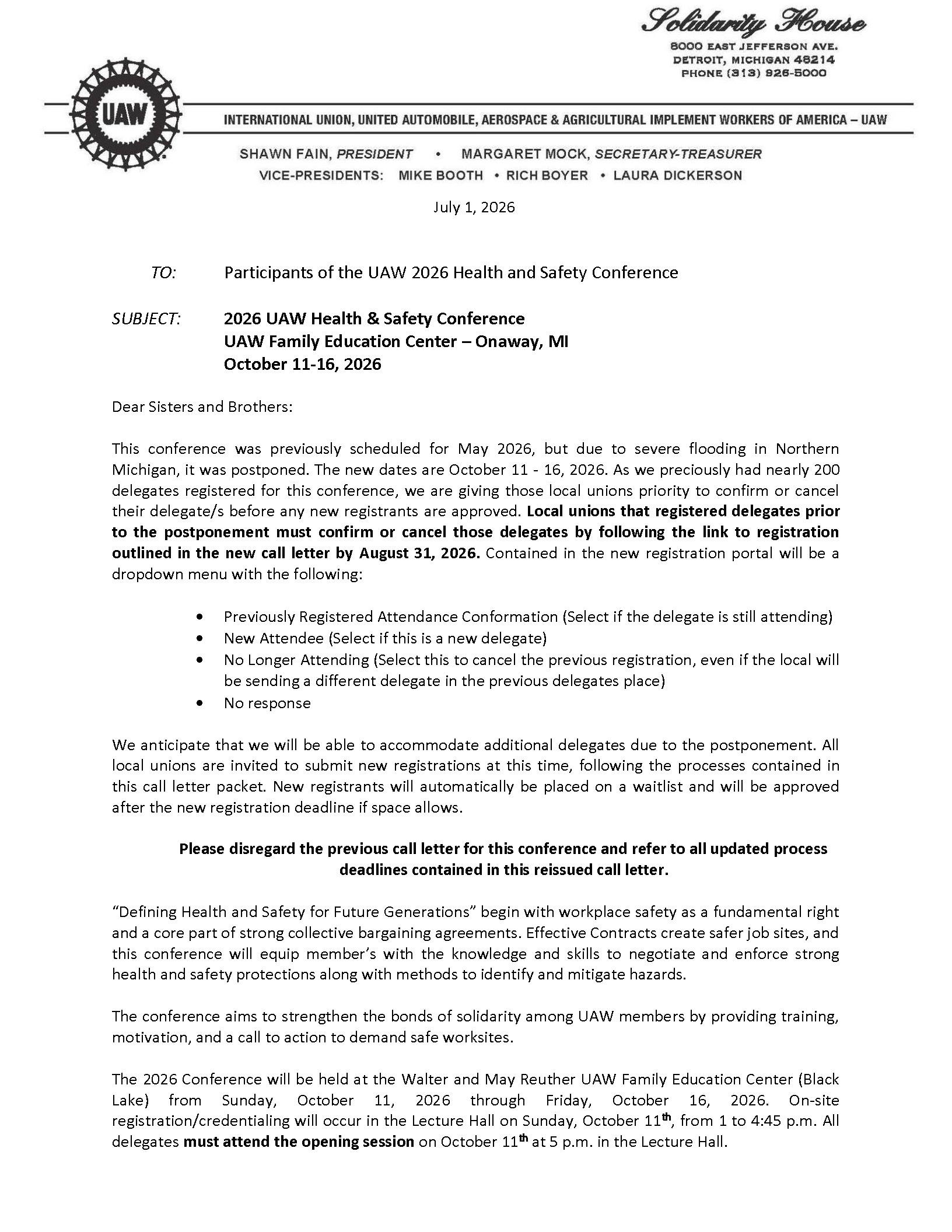
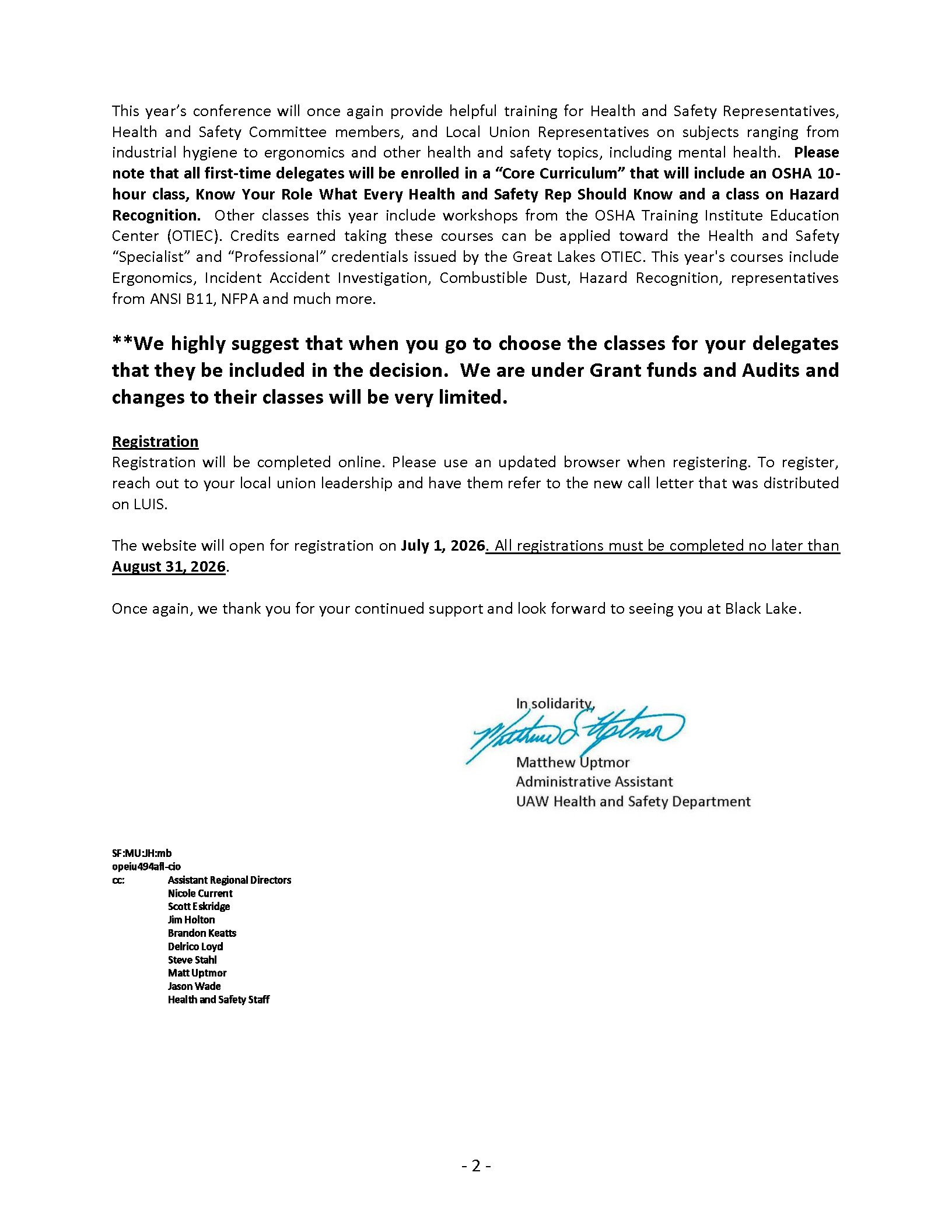
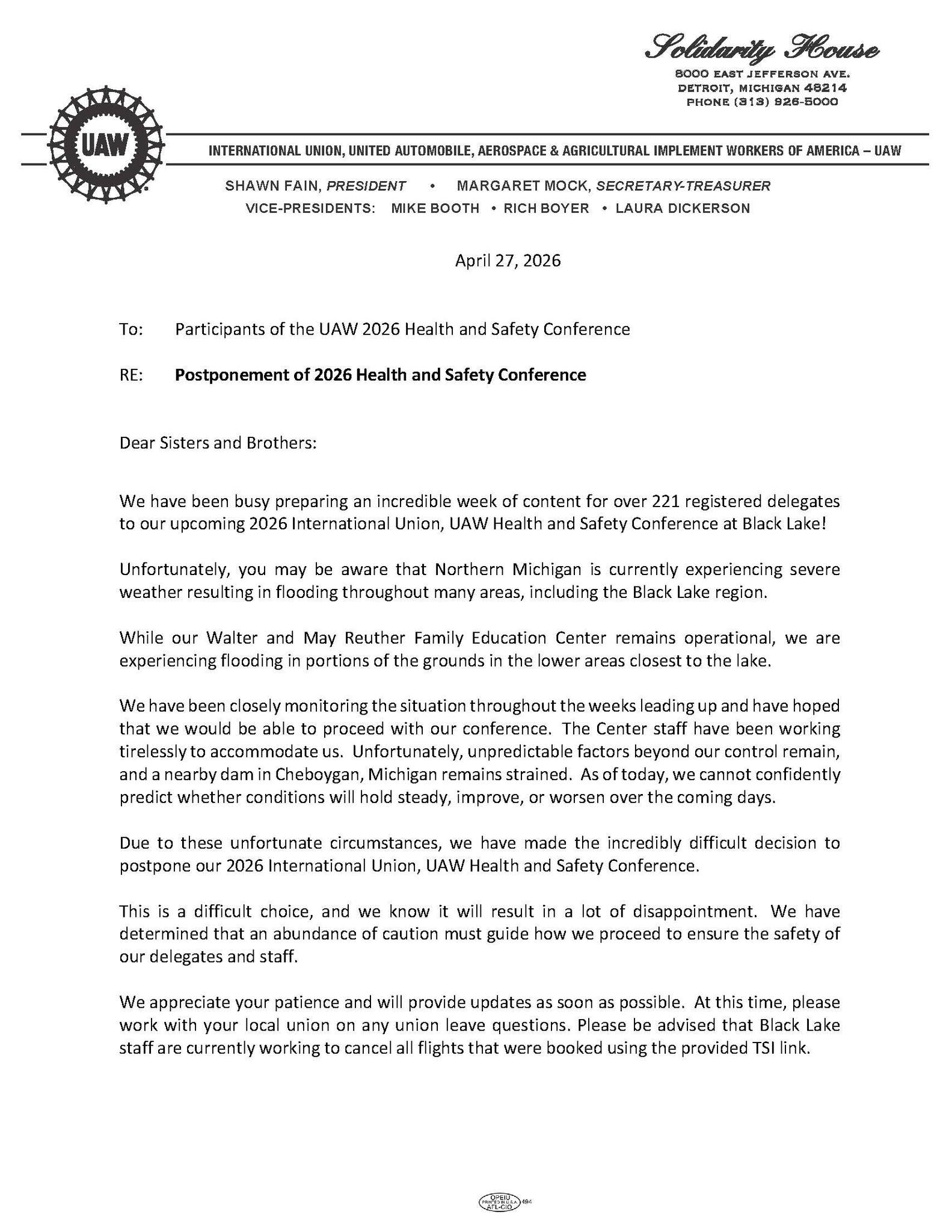
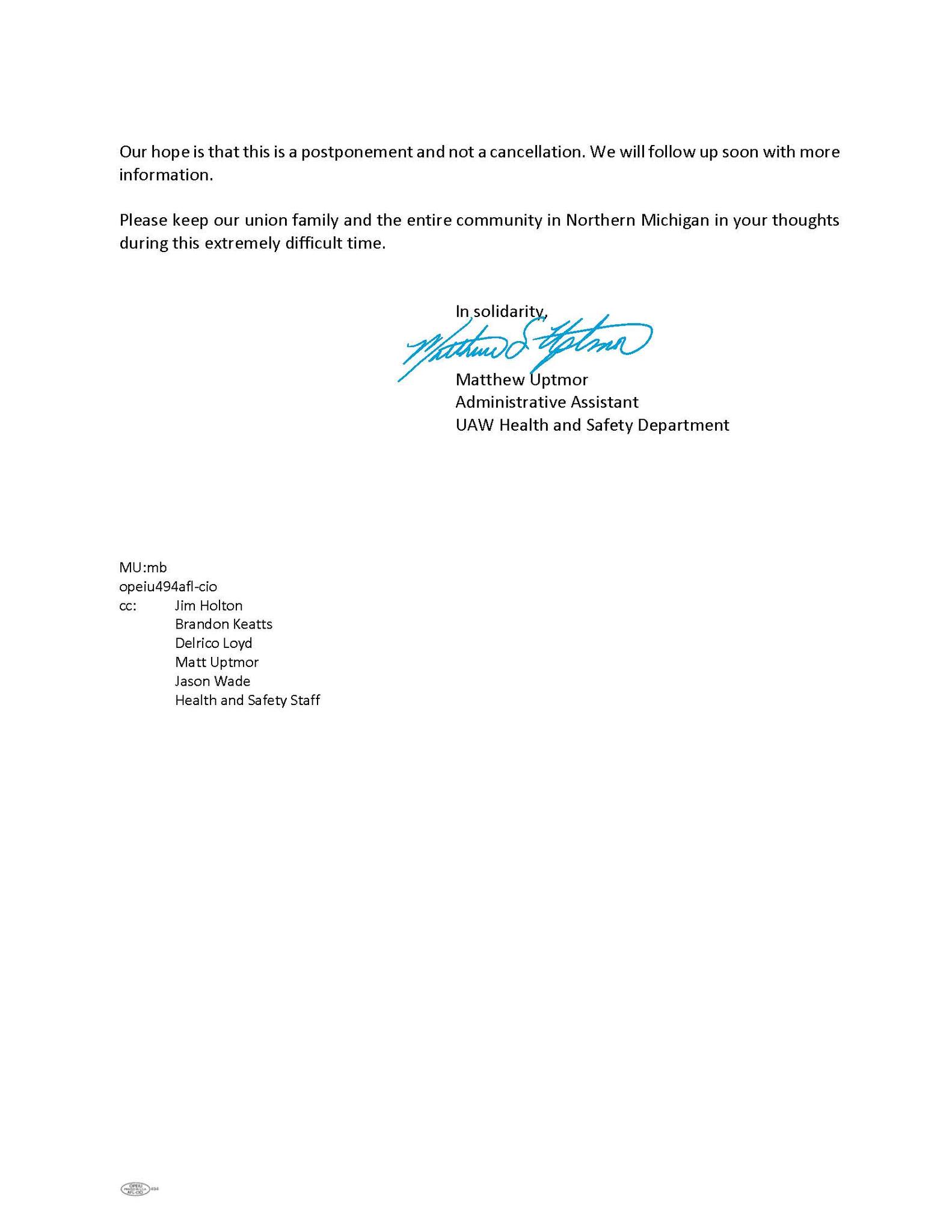
This conference was previously scheduled for May 2026, but due to severe flooding in Northern Michigan, it was postponed. The new dates are October 11 – 16, 2026. As we preciously had nearly 200 delegates registered for this conference, we are giving those local unions priority to confirm or cancel their delegate/s before any new registrants are approved. Local unions that registered delegates prior to the postponement must confirm or cancel those delegates by following the link to registration outlined in the new call letter by August 31, 2026.

Read the full letter from the UAW Health and Safety Dept. below more full details.

The 2026 UAW Health and Safety Conference has been postponed.

“This is a difficult choice, and we know it will result in a lot of disappointment. We have determined that an abundance of caution must guide how we proceed to ensure the safety of our delegates and staff.

“We appreciate your patience and will provide updates as soon as possible. At this time, please work with your local union on any union leave questions. Please be advised that Black Lake staff are currently working to cancel all flights that were booked using the TSI link.”

Read the full letter from the UAW Health and Safety Dept. below more full details.

“The UAW is devastated to learn that a member was killed on the job at Ford’s Sharonville Transmission Plant on March 16, 2026,” said UAW Vice President Laura Dickerson, UAW Ford Department Director. “No one should ever go to work and never come home. It is our sacred duty as a union to protect the life, health, and safety of our members on the job. Members deserve a workplace free of threat to life and body. Our prayers are with the family, co-workers and loved ones of our fallen brother.”

Autoworkers at Volkswagen’s Chattanooga plant have won a historic tentative agreement with the company. After making history as the first Southern autoworkers outside the Big Three to join the UAW, the 3,200 workers at Volkswagen Chattanooga have won a tentative contract deal that provides 20 percent across-the-board wage increases, affordable health care, real job security, and more.

After workers voted 3-to-1 to join the UAW in 2024, they elected a 20-member negotiating committee of their peers. After months of negotiations, the tentative deal marks a breakthrough for non-union autoworkers and manufacturing workers across the South. The tentative deal ensures that Volkswagen workers have a legally binding and enforceable agreement that guarantees fair pay, more affordable health care, safer working conditions, and clear protections against favoritism.

“For years, Chattanooga workers were told to settle for less while Volkswagen made record profits. So, the workers stood together and won their union—and now they’ve secured a life-changing first agreement,” said UAW President Shawn Fain. “This deal proves what happens when autoworkers stand up and demand their fair share. People said Southern autoworkers could never form a union or win a union contract. Volkswagen workers in Chattanooga said, ‘Watch this.’”

For workers like bargaining committee co-chair Steve Cochran, a skilled trades worker and co-chair of the Bargaining Committee, the agreement represents a turning point. “A strong contract makes sure promises are delivered. Respect and security shouldn’t be up for negotiation—and now they won’t be.”

The tentative agreement is especially significant given Volkswagen’s recent record-breaking profits. In 2024 alone, the world’s second-largest automaker reported $20.6 billion in profits—even as Chattanooga workers struggled under substandard health coverage and rising out-of-pocket costs.

Key Wins in the Tentative Agreement

  • Major Wage Increases – 20% GWI
    Substantial raises that begin to close the gap with industry standards and reflect Volkswagen’s record profits.
  • Improved High-Quality Health Care with No Increases
    Lower out-of-pocket costs, improved coverage, and protections that ensure no worker must choose between medical care and basic needs.
  • Big Bonuses Initial bonuses equaling $6,550 per worker upon ratification and additional annual bonuses of $2,550 for the life of the agreement. Thousands of dollars of additional compensation for each worker.
  • Job Security Protections
    Strong language against unilateral job cuts, shift reductions, and outsourcing—making sure VW keeps good union jobs in Chattanooga.
  • Stronger Health & Safety Standards
    Enforceable safety rules, dedicated union safety representatives, and a greater worker voice in identifying and fixing hazards on the job.
  • Paid Time Off & Scheduling Protections
    Guaranteed paid leave, fair scheduling requirements, and safeguards against forced overtime and favoritism.
  • Fair Discipline & Grievance Rights
    Clear, enforceable protections against unfair discipline and a transparent, worker-centered grievance process.
  • A Real Voice on the Job
    Rights that ensure workers have a say in day-to-day decisions that shape their work, their safety, and their future.

This historic agreement reflects significant improvements over the company’s last proposal in October, including:

  • New product commitments
  • Enhanced right-to-strike protections
  • Key newly won Job Security agreements, including protections against outsourcing
  • Thousands of additional dollars of annual compensation per worker
  • Key Skilled Trades issues addressed
  • Stronger safeguards against plant closures or the sale of operations

Workers will receive details of the tentative agreement in the coming days, followed by a ratification vote.

“This contract is proof that if you stand up and stick together, you can win a better life,” said Kelcey Smith, a worker in the paint department. “No matter where you live, or where you work, autoworkers deserve a union contract, whether at the Big Three or Volkswagen, from Detroit to Chattanooga. Volkswagen workers are showing the whole country what’s possible.”

The Chattanooga victory signals a profound shift in the Southern auto industry, as workers across the region stand up to global corporations, demand their fair share, and build a future where autoworkers—no matter where they live or what company they work for—have a collective voice and a seat at the table.

JANESVILLE, WI – UAW Local 95 Unit 14 members at Mercyhealth’s East Clinic have reached a major milestone — 100 days on strike. Since July 2, these dedicated health care workers have been standing up not just for themselves, but for their patients. They’re fighting to restore quality care and fair jobs at Mercyhealth, where high-level decisions have turned what should be good, stable caregiving jobs into overworked, underpaid positions that put patient care at risk. On Friday, workers took a moment to celebrate their strength and unity as they continue to push back against an employer that is putting profits before patients.

“There’s no question that our members at Mercyhealth East are stronger today than they were on July 2 when they first walked out,” said UAW Local 95 President Judy McRoberts. “They’ve held the line for 100 days because they know what’s at stake — the quality of care their patients receive and the dignity of their own work. Mercy East UAW members take pride in caring for their community, and they understand that you can’t deliver quality patient care when management keeps turning good jobs into low-wage, high-stress positions. Mercyhealth needs to start valuing both its workers and its patients.”

UAW members at Mercyhealth East provide care in many roles from nurses to x-ray techs, receptionists to building maintenance. If Mercy runs, it’s because of these dedicated workers. Among the key issues keeping the picket line going is the employer’s proposal to increase health care costs, which are already a strain on the workforce. Low wages and a lack of safety are other issues that mobilized the walk-out in July.

“Mercyhealth is denying us any sense of security — even those of us working late into the evenings,” said Anna Farrington, one of the UAW members on strike at Mercyhealth. “We never know who might come in at any hour, and there are so few of us on staff. We want to give our patients the bestcare and comfort we can, but how are we supposed to do that when we don’t even feel safe ourselves? Mercyhealth didn’t seem to have any trouble finding security guards once we started our picket line — I guess it was possible after all.”

Between 2020 and 2023, Mercyhealth System brought in over $2 billion in total revenue — more than enough to ensure safe staffing and quality patient care. Yet instead of investing in patients or frontline caregivers, President and CEO Javon Bea pocketed $36.2 million during that period, including $11.5 million in 2023 alone. At a rally on Friday, community and political allies joined the Mercy East strikers to call out the hypocrisy and greed of one of the region’s largest employers.

Last week, 176 delegates came to this institute to sharpen their skills as grievance handlers. What they got was so much more…

UAW Local 6000, representing 16,000 State of Michigan employees across 1,200 worksites, sounded the alarm with Senator Sarah Anthony (D-Lansing) in the Capitol as October 1 shutdown deadline looms.

LANSING — With October 1’s deadline for a Michigan government shutdown looming large in Lansing, the UAW sounded the alarm today about the critical State of Michigan (SOM) services that are in jeopardy. UAW Local 6000 represents 16,000 SOM employees across 1,200 worksites in Michigan, including the Department of Health and Human Services, Secretary of State, and state corrections offices, among other critical departments.

“UAW Local 6000 members are on the front lines of ensuring the safety and well-being of children and vulnerable populations, providing critical services to people who depend on basic necessities essential to their survival,” said UAW Local 6000 President Rachel Dickinson. “When UAW Local 6000 members aren’t on the job, Michigan feels it fast—unemployment claims don’t get processed, SNAP and Medicaid slow down or grind to a halt, public safety is put at risk. This isn’t just paperwork; it’s people’s lives and the stability of our state.”

Standing shoulder-to-shoulder with UAW Local 6000 members in Lansing today, Senator Sarah Anthony (D-Lansing) further elaborated on the stakes of the House’s bad budget that is spiraling Michigan towards a shutdown.

“As the daughter of two proud UAW retirees, I am proud to stand with UAW Local 6000 today and every day,” said Senate Appropriations Chair Sarah Anthony (D-Lansing). “When we support our state employees, we support the very fabric of Michigan’s success. Senate Democrats will keep standing with our state workers and working around the clock until we pass a balanced state budget that funds essential human services, protects our workers, and invests in the future of our state.”

This week, SOM employees are expecting to see two-week notice letters in their mailboxes warning of the imminent shutdown on October 1. The ominous deadline comes following the Republican-majority Michigan House’s passage of a ruthless slash and burn budget that would impact working-class communities the harshest.

“It’s time for House Republicans to quit messing around with people’s livelihoods and the core services on which Michiganders rely,” said Senate Majority Leader Winnie Brinks (D-Grand Rapids). “These folks do the oftentimes unglamorous work of keeping our state running, yet have been maligned as ‘waste, fraud, and abuse.’ We won’t stand for it. In this moment, they deserve honest leadership from the legislature and nothing less.”

Detroit, MI – This year, the United Auto Workers (UAW) celebrates its 90th anniversary. Founded in 1935, the UAW has been at the forefront of the labor movement, winning historic gains for working people and standing at the center of major struggles for civil rights, social justice, and economic fairness.

To mark the occasion, the union has released a new video highlighting the UAW’s nine decades of bold action—from the Flint Sit-Down Strike of 1936 to the Stand Up Strike of 2023 and beyond. The video lifts up the UAW’s proud tradition of fighting for fair wages, strong benefits, dignity on the job, and broader social and political change that has improved the lives of all working-class Americans.

“Our members have always understood that our fight is bigger than any one contract or workplace,” said UAW President Shawn Fain. “For 90 years, the UAW has taken on billionaires and corporate power, and we’ve raised the standards for the entire working class. Our mission remains to fight the bosses, build worker power, and win a better world for working people.”

The full video is available here.

UAW 90th Anniversary Video Script

They said it couldn’t be done. But in 1935, autoworkers came together to form the United Auto Workers. Just a year later, they took bold action and changed American history when they launched the 1936 Flint sit-down strike. For 44 days, they refused to leave the GM plants until their voices were heard. Their actions set off a wave of strikes nationwide, igniting a new industrial labor movement.

From those first bold strikes to the Stand-Up Strike of 2023, the UAW has never stopped fighting. We won what no one thought possible: good wages, health care, pensions, a voice on the job, and dignity at work. We didn’t just raise the floor for autoworkers—we raised the bar for working-class Americans.

And we didn’t stop at the workplace. We marched with Dr. Martin Luther King Jr. in Detroit’s Walk to Freedom, helped organize the March on Washington, and stood with him in Memphis in 1968. We fought alongside Nelson Mandela and the people of South Africa—pushing for sanctions against apartheid when others stayed silent. And we’ve stayed true to these same principles — whether in South Africa, Palestine, or beyond.

We stood with César Chávez and the United Farm Workers, joined the fight for women’s rights, and defended immigrant workers. We backed the G.I. Bill for returning veterans, helped pass the Occupational Safety and Health Act, and fought for the Clean Air and Clean Water Acts.

When trade deals like NAFTA threatened our jobs, we sounded the alarm, and we have remained vigilant in fighting to protect our communities and our jobs. When the auto industry was on the brink in 2009, we sacrificed to save it—and then fought to win back what was ours. 

Today, as billionaires try to take more and make us settle for less, the UAW is on the rise again: We’re organizing higher education, battery plants, and new sectors of the economy. Winning record contracts at Ford, General Motors, Stellantis, Daimler Truck, Cornell University, and more. And proving—once again—that nothing moves without workers.

Ninety years in, our fight is far from over. But our spirit? Unbreakable. UAW. A fighting spirit. Since 1935.

GLENDALE, KY—Today, the UAW released a powerful new video featuring BlueOval SK workers calling for a union to win a real voice on the job, especially when it comes to their health and safety. The video ties the effort by workers at Ford Motor Company who pushed for safer factories nearly a century ago to the high stakes fight today as workers at its joint venture battery plant in Kentucky gear up for an NLRB election in a few weeks.

The new video, “BlueOval SK Union Drive Echoes Workers’ Historic Safety Fight at Ford” is available for use by the media here.

After months of an aggressive union-busting campaign driven by the company, production and maintenance workers at BlueOval SK, Ford’s joint venture battery plant in Glendale, Kentucky, will finally have their chance to vote in a union election on August 26 and 27. The vote will be conducted by the NLRB, with ballots counted starting at 8 p.m. on August 27.

In the video, BOSK workers connect their fight for basic protections today to the UAW’s historic fight at Ford to make auto plants safer in the 20th century. “It’s our time to sit across the table from management as equals,” narrates several BOSK workers in the new video. “We want a legally binding contract that guarantees our wages, health care, PTO policies, and health and safety.

“Workers in Michigan began a wave that changed America,” the video’s narration continues. “Battery workers in Ohio, Tennessee, and Indiana have already taken this step and won. Now, it’s our turn.”

Currently, BlueOval SK is the only battery plant involving the Big Three that is non-union. GM’s Ultium plants in Ohio and Tennessee already operate under a UAW contract, and Stellantis’ StarPlus Energy plant in Indiana joined the union and ratified their local agreement earlier this year.

“A supermajority of BOSK workers filed for this election back in January because they were done with broken promises and unsafe working conditions. They were done being left out of decisions that impact their health and their futures,” said UAW Region 8 Director Tim Smith. “Just like Ford workers in the 30s and 40s, these workers are seeking safer working conditions, the affordable health care they were originally assured, and a voice on the job. They’re ready to get it.”

Kentucky taxpayers have poured millions of public dollars into this plant, and workers have expressed they should have a fair shot at choosing their union. Every elected official in Kentucky who claims to stand on the side of the working-class should look at BOSK right now to see what courage looks like.

Despite illegally firing and retaliating against union supporters and holding unlawful closed-door meetings to intimidate workers, the company has not stopped BOSK workers from moving forward. Workers remain determined to vote for a union and have a voice on the job.

Full transcript of the newly released UAW video featuring BlueOval SK workers ahead of their union election this month: 

[Narrated by several different workers from BlueOvalSK in Glendale]

In 1941, Ford auto workers changed history.

Facing workplace injuries, exhaustion, and deaths on the job, Ford workers took a stand that would echo generations. 

They came together and organized and—as United Auto Workers—won the right to negotiate for all of their working conditions. 

This history is not just a source of pride; it’s a lesson in solidarity to show what’s possible when working class people stand together. 

Today, Kentucky is the center of the battery belt. We’re building the future of the auto industry, and this transformative moment requires the same worker power that guarantees our safety and job security.

Whether in Dearborn, Michigan or Glendale, Kentucky, the technology may differ, but the risks remain the same. 

Wherever corporate greed puts our lives at risk, the fight for a safe workplace binds us together. 

 It’s our time to sit across the table for management as equals. 

We want a legally binding contract that guarantees our wages, health care, PTO policies, and health and safety. 

Workers in Michigan began a wave that changed America. 

Battery workers in Ohio, Tennessee, and Indiana have already taken this step and won. 

Now it’s our turn. 

I’m ready to have a voice at BOSK. 

I’m ready to have a voice at BOSK—as United Auto Workers.
GLENDALE, KY – The UAW is calling on the National Labor Relations Board to investigate Ford and BlueOval SK (BOSK) for violating federal labor law before it sets the date for an election to ensure a fair and democratic vote — one free from illegal employer intimidation, retaliation, and coercion.

A supermajority of workers at BOSK — the electric vehicle battery joint venture between Ford and SK On — filed for a union election with the UAW in January, demanding safer working conditions, the affordable health care they were originally promised, and a voice on the job. But since then, BOSK and Ford have launched a scorched-earth anti-union campaign designed to scare workers and chill support.

Instead of respecting the legal process or workers’ right to choose, BOSK has illegally fired and retaliated against vocal union supporters, unlawfully forced workers into closed-door meetings, and threatened to shut down the plant. The company has bought up anti-union ads, distributed anti-union swag, and brought in high-priced consultants to expose workers to non-stop anti-union campaigning.

“Ford knows better. For over 80 years, Ford workers have had a union and a voice. But at BOSK, they’re doing everything they can to stop these workers from having the same thing,” said Laura Dickerson, UAW Vice President and Director of the Ford Department. “You can’t have a fair vote when the company is flooding the plant with fear and propaganda.”

Workers say the company’s actions have poisoned the atmosphere around the election — especially in a workplace already plagued by serious safety concerns. A recent Louisville Courier-Journal investigation revealed that BOSK workers have faced toxic chemical exposure, broken bones, and faulty safety equipment.

“BOSK wants to act like there are no safety issues here. But the chemicals we work with are dangerous.  We want the ability to speak up and make things safer in a contract. That’s what a union is about,” said Rob Collett, a Production Associate.

Other workers described being told to work without proper gear and warned not to talk about forming a union.

“These BOSK workers are brave as hell,” said UAW Region 8 Director Tim Smith. “They stood up and organized because they want what everyone deserves — a safe job and a voice at work. Battery jobs are growing fast here in Kentucky, but they should be good, safe union jobs — not jobs where workers get hurt and silenced. We need a fair shot to vote without the company trying to rig the outcome. Elected leaders can’t look the other way while this industry grows — they need to have workers’ backs. Who are we? U-A-W!”

Workers and the UAW are calling on the NLRB to hold the company accountable until the Board can begin investigating the company’s actions and restore the conditions for a free and fair vote.

“We are excited to vote yes! We have been waiting for this for a long time. However, we are asking the NLRB to ensure a fair playing field,” said Emily Drueke, Quality Department.

The campaign at BOSK is part of a growing wave of worker organizing in the EV battery industry, including major wins at Ultium Cells in Ohio and Tennessee. Workers across the South are standing up — and demanding what they’ve earned: a union and a voice on the job.