Tag Archive for: Local 2110

UAW TOP Wheel Navy Blue and White

The Museum of Fine Arts, Boston is laying off 33 employees amid a growing $13 million budget deficit, triggering renewed tensions with its unionized workforce and raising concerns about the impact of cuts on curatorial and scholarly positions. Please see Sarah Cascone ArtNet News Article dated January 30, 2026 for additional information.

UAW Local 2110 TOP logo

Staff at the Metropolitan Museum of Art in New York City are officially unionized. The newly unionized group, represent members across 50 departments of the Manhattan Institution and will become a part of UAW Region 9A, Local 2110.  Please see Isa Farfan’s Hyperallergic Article dated January 16, 2026 to read more.

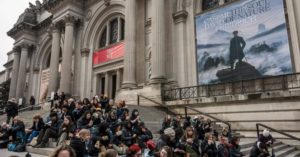
Group of people sitting on sitting on steps in front of building.

The Metropolitan Museum of Art staff voted to unionize with a 76% majority in a National Labor Relations Board (NLRB) to become members of UAW Region 9A, Local 2110. The ballot count was 542 Yes and 172 No.


Staff of the Metropolitan Museum of Art in New York, NY, have voted by a 76% margin in a National Labor Relations Board election to unionize with UAW Local 2110. The ballot tally was 542 yes votes for the union with 172 votes against. The ballots of an additional 100 people remain sealed because they were challenged by the Museum which objected to inclusion of these staff in the union. The eligibility of staff in these positions will be determined through a mutually agreed upon arbitration process after the union is officially certified by the National Labor Relations Board.

Workers at the Museum had been organizing for over four years before the election, over concerns about job security, pay equity and greater transparency about employment policies.

“I’ve worked at The Met for 31 years and I truly love it but our expertise and our labor have real value deserving of recognition,” said Stephanie Post, a Digital Archivist, “By unionizing, we aren’t just protecting our own jobs—we are building a collective voice to ensure every staff member, now and in the future, gets the respect and protection they deserve.”

”We won because we were able to convince our colleagues that they don’t have to accept whatever is offered to them, that their experience and hard work has earned them a seat at the table,” said Rebecca Capua, a conservator who has worked at the Museum for sixteen years.

The unit is composed of staff across fifty different departments of the Museum and includes curators, conservators, librarians, sales specialists, visitor experience coordinators, development officers, archivists, digital and IT staff, and more.

Jonathan Farbowitz, a conservator said: “I’m so inspired by the way Met staff across departments have come together to make this historic victory happen.”

Tiffany Camusci, Data Analyst added: “There is no stronger feeling of solidarity than working together with my colleagues to establish our union.”

Thousands of museum workers have organized since the pandemic. Local 2110 UAW already represents workers at multiple art museums and other cultural institutions including the Museum of Modern Art, the MFA, Boston, the Guggenheim, the Whitney Museum, the Jewish Museum, the Portland Museum of Art, MASS MoCA, the Hispanic Society Museum and Library, the New York Historical Society, the Shed, the Emily Dickinson Museum, the Tenement Museum, the Harriet Beecher Stowe Center, the Brooklyn Academy of Music, Film at Lincoln Center, Film Forum and Anthology Film Archives.

“Organizing with my Met colleagues was an incredible, galvanizing experience that I will never forget,” said Alison Clark, a Collections Manager in Asian Art who has worked at the Museum for over 20 years. “Unionizing with UAW Local 2110 is only our first step and we look forward to negotiating a fair and equitable contract that reflects staff needs and priorities.”

New York, NY— This morning, Local 2110 of the UAW petitioned the National Labor Relations Board for a union election for nearly a thousand full-time and part-time professional and non-professional staff of The Metropolitan Museum of Art.

Workers cite long term pay inequities, lack of job protection and ever-increasing workloads as reasons for the unionization efforts.

Initial conversations about unionizing started in 2020, with staff sharing concerns generated by the pandemic. In 2022, the group reached out to UAW Local 2110, known nationally for organizing staff at major cultural institutions, including the Museum of Fine Arts, Boston, MoMA, New Museum of Contemporary Art, Guggenheim Museum, MASS MoCA, the Whitney Museum of American Art and others.

“The union effort was started during the pandemic by a group of long-time staff who know the Met extremely well and have been through multiple crises where we have lost staff and benefits.,” says Rebecca Capua, a Conservator who has been employed at the Met for 16 years. “We want our jobs at the Met to be viable long term careers — for ourselves and for those who come after us.”

“The Met is an amazing place. I’ve worked here almost 20 years, and love it,” says Alison Clark, Collections Manager. “However, the Museum often makes decisions without considering or consulting staff, such as changes to our Work from Home policy and erosion of our health and other benefits. Right now, we’re contending with several large scale capital projects that displace people and create a lot of additional work for the staff. Unionizing is the only way for us to have a strong collective voice to address concerns with the Museum.”

“Being involved in the organizing for our union has really broken down barriers between us as coworkers who work in many different departments at The Met,” says Tiffany Camusci, a Data Analyst who has worked at the Met since 2023. “As a newer employee, I got involved because a union will empower us to address our pay and our opportunities for career advancement at the Met. It’s rewarding to know that so many of my colleagues share similar concerns and want to address our workplace needs collectively. ”

The last few years have seen thousands of museum workers unionize. Employees at the MFA, Boston, the Guggenheim, the Whitney, the New Museum, the Brooklyn Museum, MASS MoCA, the Jewish Museum, The Dia Foundation, the Hispanic Society Museum and Library, the Portland Museum of Art are just some of the institutions where workers have organized with UAW Local 2110 . Many have echoed similar issues of low pay, lack of job security, and little or no transparency about institutional plans. The economic fallout caused by the global Covid-19 pandemic, which further exposed the insecurities of non-unionized workplaces, further galvanized workers to organize.

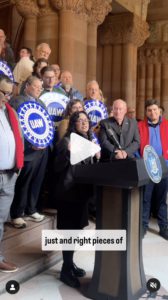
UAW workers in NY lobby for unemployment reforms that would allow adjunct faculty and other contingent workers in higher education to collect unemployment during semester breaks.

View the IG post : Region 9 UAW Members Lobby for Higher Education Workers in NY

New York, NY  – On Thursday, June 6, staff at the American Folk Art Museum will vote on whether to unionize with Local 2110 UAW. The wall-to-wall unit includes curators, retail staff, educators, IT, communication staff, and others. The Museum is the latest in a growing movement of museum workers to organize.

Staff members cite lack of transparency and a desire for fair wages, benefits, recognition, and sustainable working conditions as reasons for unionizing. 

“I love the Museum, its exhibitions and programs,” Jean Seestadt, Manager of Events, says, “but I want employment here to be sustainable over a longer period. We’ve seen too many great colleagues leave.” 

Eve Erickson, Executive Assistant, adds: “The staff are an important part of the Museum and by unionizing, we have a voice in our own conditions of work and our future at the Museum.”

The last few years have seen thousands of workers in cultural institutions decide to unionize. Employees at the Jewish Museum, The Dia Foundation, the Guggenheim Museum, Whitney Museum of American Art, the Brooklyn Museum, the Hispanic Society of America, Film Forum, Anthology Film Archives, MASS MoCA, Film at Lincoln Center, Studio in a School, the Portland Museum of Art, and the Museum of Fine Arts, Boston voted to unionize with Local 2110 since November 2020. Many reference similar issues of low pay, and lack of job security or opportunity.

The American Folk Art Museum, located at 2 Lincoln Square on the Upper West Side has existed for over fifty years. 

Local 2110 UAW also represents workers at the Museum of Modern Art, the Guggenheim, the Museum of Fine Arts, Boston, MASS MoCA, the Whitney Museum of American Art, the Brooklyn Museum, Columbia University, Film Forum, Teachers College, ACLU, Center for Reproductive Rights, The New Press, and many more. The union has a reputation for its successful organizing and bargaining. 

NORTH ADAMS, MA — Unionized employees of MASS MoCA will go on strike starting Wednesday, March 6 if no agreement on wages is reached with the Museum before then. Employees will begin picketing the Museum starting 8 am on Wednesday, March 6 and will picket daily until an agreement is reached.

The employees’ union, part of Local 2110 UAW, was originally formed in April of 2021. After a one day strike in August of 2022, employees reached an agreement on a first contract which allowed them to re-open the agreement in October 2023 to negotiate further wage increases. Negotiations on the wage reopener have been ongoing for four months but no agreement has been reached.

Fifty-eight percent (58%) of the 120 employees are earning just $16.25 per hour. Average pay for full-time employees is $43,600. According to The Economic Policy Institute’s family budget calculator, for a modest living in Berkshire County, a single individual with no children needs to earn approximately $47,000 per year while a family of four needs about $118,000. The Union is seeking to raise the hourly minimum rate to $18.25 by October of 2023 and is also seeking a minimum 4.5% increase this year.

MASS MoCA sent out a March 1 email to union members characterizing its rejection of the Union’s offer: “The Museum cannot agree to terms that will diminish our mission or operational sustainability, upend vital partnerships, reduce our programs, or fundamentally change our creative workplace culture. Simply put, MASS MoCA has been and will continue to be moved to adopt proposals that are balanced, fair, sustainable, and honest.”

The Union says the difference between its and the Museum’s base wage proposal is only an additional $150,000 for this year, and that workers need the money just to make ends meet. Moreover, the Union asserts that the Museum has increased the number of higher-paid management positions at the expense of the unionized staff.

“MASS MoCA seems out of touch with our needs and concerns as employees,” said Meg Labbee, a 25 year employee of the Museum who works in Artists Services. “They say the arts and artists come first but they need to show some regard for the people who work here. We love the work, but we deserve respect and fair conditions.”

Labbee, who is from the nearby town of Adams, adds, “Many of us live locally and our pay has not kept pace with the cost of living. By raising pay to something more livable, MASS MoCA would not only be supporting its employees, but helping lift the community, MASS MoCA’s rejection of our reasonable proposal has left us with no choice but to strike the institution we love.”

The March 6 strike deadline is not the first time bargaining with the Museum has been contentious. In 2022, during initial contract bargaining, the Union filed unfair labor practice charges with the National Labor Relations Board over the Museum’s bad faith bargaining, and employees engaged in a one-day strike. Then, this past November, the Union filed a complaint against the Museum with the Occupational Safety and Health Administration (OSHA) when the Museum ordered workers to remove flooring contaminated with loose asbestos without proper equipment or training. OSHA has since issued test results confirming the presence of asbestos, cited necessary corrections to the Museum and is conducting an ongoing investigation.

In April 2021, the MASS MoCA staff voted overwhelmingly to unionize with UAW Local 2110. The bargaining unit includes approximately 120 employees who work as educators, curators, custodians, museum attendants, box office staff, art fabricators, technicians, and other administrative and professional staff. UAW Local 2110 is a technical, office and professional union that represents many museums and cultural institutions in the northeast including the Museum of Modern Art, the MFA, Boston, the Portland Museum of Art, the Whitney Museum of American Art, the Guggenheim, the Jewish Museum, the Harriet Beecher Stowe Center, the Brooklyn Academy of Music, and other non-profit and educational institutions.
UAW WELCOMES BROOKLYN ACADEMY OF MUSIC EMPLOYEES

UAW ADDS OVER 14,000 NEW MEMBERS SINCE AUGUST 2018

Eighty-two percent of workers at the Brooklyn Academy of Music voted to join the UAW last week joining UAW Local 2110.

The administrative and cinema workers will now be able to bargain following reductions in benefits such as health care and 401(k) matching, and conversion of full-time jobs to part-time jobs among other issues. The 145 employees petitioned for an election in April.

“We are here because we believe in BAM’s mission,” Jesse Trussell, a film programmer who helped organize at BAM, said on Twitter when petitions were filed. “Our union will make BAM stronger, more democratic and more sustainable.”

Trussell said that BAM administrative staff needs a “powerful voice” and said workers were inspired by similar successful campaigns at the Tenement Museum and the New Museum.

The Workers Defense League in New York recently honored UAW Local 2110 Maida Rosenstein during the group’s 81st anniversary dinner May 16. Rosenstein has always given priority to organizing new workers. She has been involved in graduate worker campaigns at New York University and Columbia, at a host of nonprofits and museums, and in higher education. For more than 30 years, she has strongly promoted membership-led, grassroots union activity, in contract negotiations campaigns, new organizing and political action. As a result, Local 2110 has developed a broad group of leaders, and a degree of mobilization and activity that stands out within the labor movement.

Rosenstein’s first successful strike was in high school when she led a “pants strike” to force the school to allow girls to wear pants. She and her classmates were reprimanded and sent home, but a week later the rules were changed and girls were allowed to wear pants to school. The strike taught her that collective action was a potent weapon in promoting women’s rights.

After receiving a degree in art from Rutgers University, she became a university clerical worker, and in 1981 she joined District 65 UAW’s organizing committee at Columbia University. The goal was to organize 1,100 clerical workers, and the campaign, which brought together her feminist views and her commitment to workers’ rights, was a tough one. There were years of legal delays and a vicious anti- union campaign in which the university claimed that the union would interfere with the highly personal relationship between a secretary and her boss. She learned the basics of organizing and the drive was transformative for her. After the union won the election in 1983, she became a fulltime organizer and ultimately was elected as vice president and then president of UAW Local 2110 (the successor to the District 65 Technical, Office and Professional Division).

Rosenstein serves as the vice chair of the UAW New York State Political Action Council and is chair of the UAW International Advisory Council on Technical, Office and Professional Workers. She is also elected to the New York State Committee of the Working Families Party.

Other honorees included Robert Martinez Jr., president of the International Association of Machinists and Aerospace Workers and James Slevin, president of Local 1-2, Utility Workers Union of America.