Wildland fire smoke presents a major hazard to workers and the public. Right now, parts of the United States and Canada have extremely high levels of ozone and particulate matter in the air due to the ongoing wildland fires. The continued excessive heat only makes the situation more hazardous for workers. This is not just a hazard for people outdoors, wildland fire smoke exposure can happen indoors, too, through open doors and windows and through HVAC systems which cannot filter this number of particles.

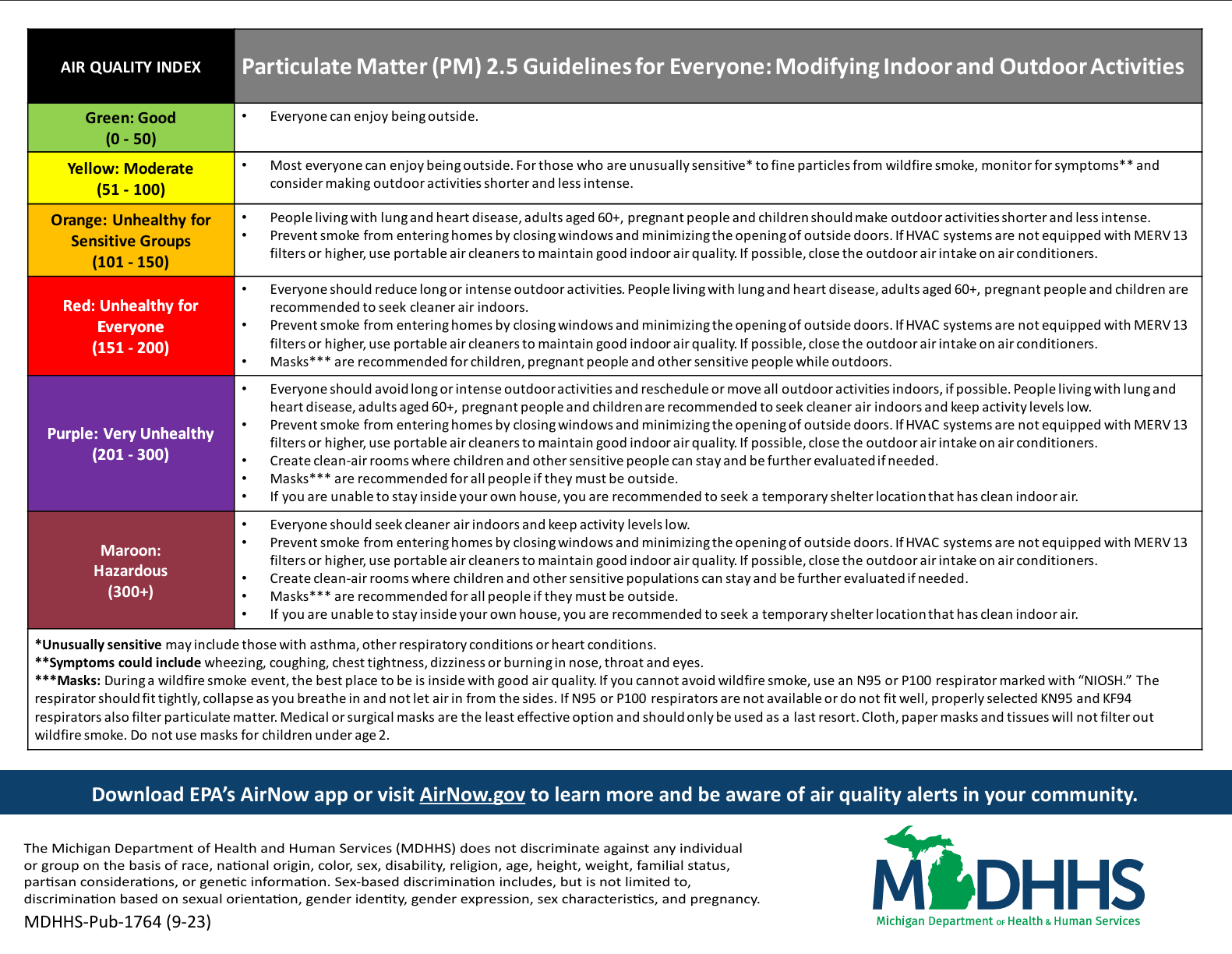
The U.S. Environmental Protection Agency (EPA) Air Quality Index (AQI) is a range of air quality from “Good” to “Hazardous” based on levels of particulates in the air. Each level carries greater risks for workers and members of the public, especially those who are older or have underlying health conditions. The Michigan Department of Health and Human services has a helpful chart displaying the EPA Air quality and guidelines for each level:

Air quality index graphic


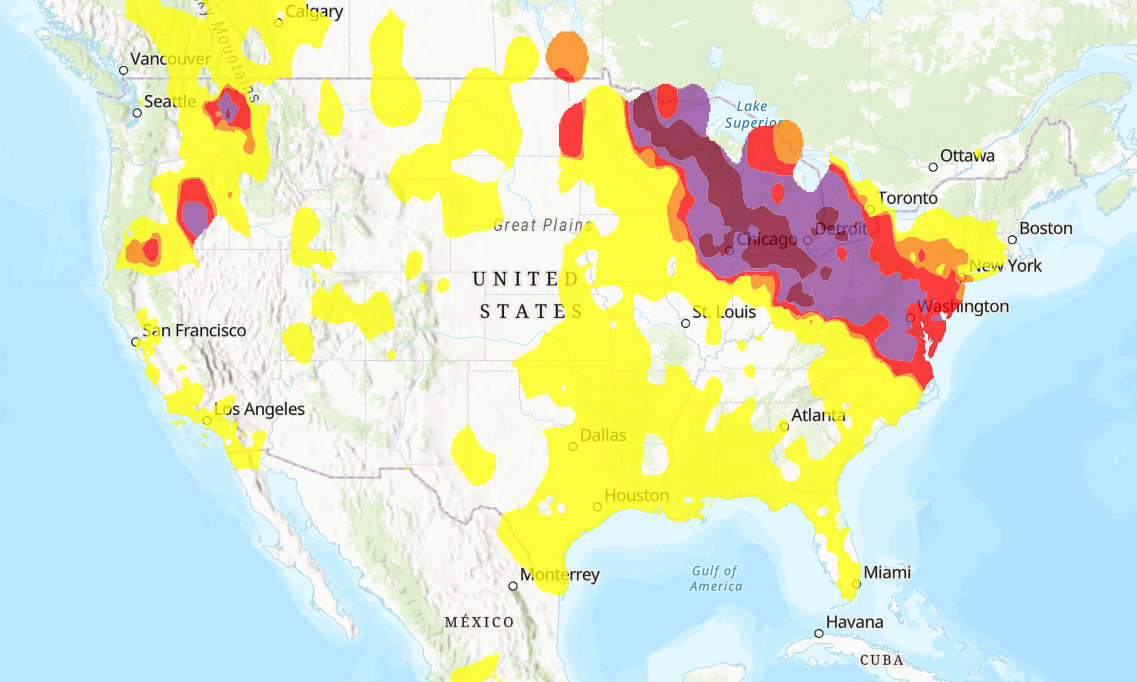
The EPA runs the AirNow Fire and Smoke Map, in partnership with the U.S. Forest Service, which provides information that you can use to help protect your health from wildland fire smoke. As of 12 pm Eastern today, this is what the map looked like:

Screenshot of the air quality map as of 1 pm ET on July 17, 2026.

Symptoms and health effects from exposure to wildland fire smoke can vary. Some workers may be at higher risk from wildland fire smoke because of their age or health conditions, such as heart or lung disease. Working long hours or doing physically demanding jobs can also increase risk because heavier breathing causes more smoke to be inhaled. According to the National Institute for Occupational Safety and Health (NIOSH), exposure to wildland fire smoke can lead to several health effects, including:

• Symptoms such as eye irritation, sore throat, wheeze, and cough,
• Asthma and chronic obstructive pulmonary disease (COPD) exacerbations,
• Bronchitis and pneumonia,
• Adverse birth outcomes, and
• Cardiovascular (heart and blood vessel) outcomes

NIOSH also provides information to help employers and workers to take steps to limit exposure to wildland fire smoke. If work must be done in smoky conditions, especially for long periods, or if a worker is sensitive to smoke and experiences health effects, the following measures can help reduce smoke exposure:

• Frequently monitor air quality conditions in the area by visiting the Environmental
Protection Agency (EPA) US Fire and Smoke Map or the state health department’s air
quality website
• Relocate or reschedule work tasks to smoke-free or less smoky areas or times of the day
• Reduce levels of physical activity, especially strenuous and heavy work
• Require and encourage workers to take frequent breaks in places that are free from
smoke
• Limit the worker’s smoke exposure by making accommodations for that worker to
perform their duties indoors or in a location that reduces exposure to smoke
The most protective option when air is unhealthy is to stay indoors. To reduce exposure to
wildland fire smoke while working indoors, employers or building managers can:
• Ensure that windows and other building openings such as loading docks are kept closed
to reduce overall smoke exposure inside
• Operate heating, ventilation, and air conditioning (HVAC) systems in the re-circulate
setting or temporarily reduce the amount of outdoor air supplied to the building
• Install the highest efficiency filters recommended by the designer or manufacturer of
the HVAC system.
• Install air cleaners equipped with high-efficiency particulate air (HEPA) filter or
electrostatic precipitators. Do NOT use ozone or ion generating devices. These can
make air quality worse, especially for people with underlying health conditions.

If workers must be outside, respirators may be one of the easiest, and in some cases the only control to implement for limiting a worker’s exposure to the particulate matter in wildland fire smoke. Employers may need to consider alternative controls and solutions when respirators are not easily available.

If an employer requires their employees to use respiratory protection to limit smoke exposure, they must always do it as part of a comprehensive respiratory protection program as required under the Occupational Safety and Health Administration’s (OSHA) Respiratory Protection standard (29 CFR 1910.134). When respirators are used on a voluntary basis in an occupational setting, employers should follow the OSHA requirements for the voluntary use of respirators.


Things to remember about respirators and other masks:

• Filtering facepiece respirators (like N95 or P100 respirators) only protect against
exposures to particles like the particulate matter in wildland fire smoke. They do not
protect against gases or other non-particle exposures.
• Tight-fitting respirators cannot be used by people with facial hair that interferes with
the face seal.
• Wearing a respirator or mask, especially if it is hot or you are physically active, can
increase the risk of heat-related illness. Take breaks often and drink water.

“UAW treats the health and safety of all workers with the utmost importance, and we urge all employers to do the same. Our International Health and Safety Department has provided detailed, relevant information on wildfire smoke and air quality to union representatives across the country to aid and support local unions and regions in addressing inquiries related to this matter. Additionally, our Health and Safety Department is on high alert and ready to provide further assistance. We urge members who have questions or are experiencing issues to contact their local union representatives. 

Many UAW workers are already subjected to working in extreme heat where doors at their worksite cannot be closed. This compounded with hazardous air quality creates an unsafe work environment. We call on employers to put health and safety of all workers first; including shutting down work if hazardous air quality cannot be mitigated with HVAC systems and PPE. The U.S. Environmental Protection Agency provides clear guidelines on air quality and we expect all UAW employers to abide by these standards and all contractual language. We will rigorously enforce our contracts to protect our members.” 

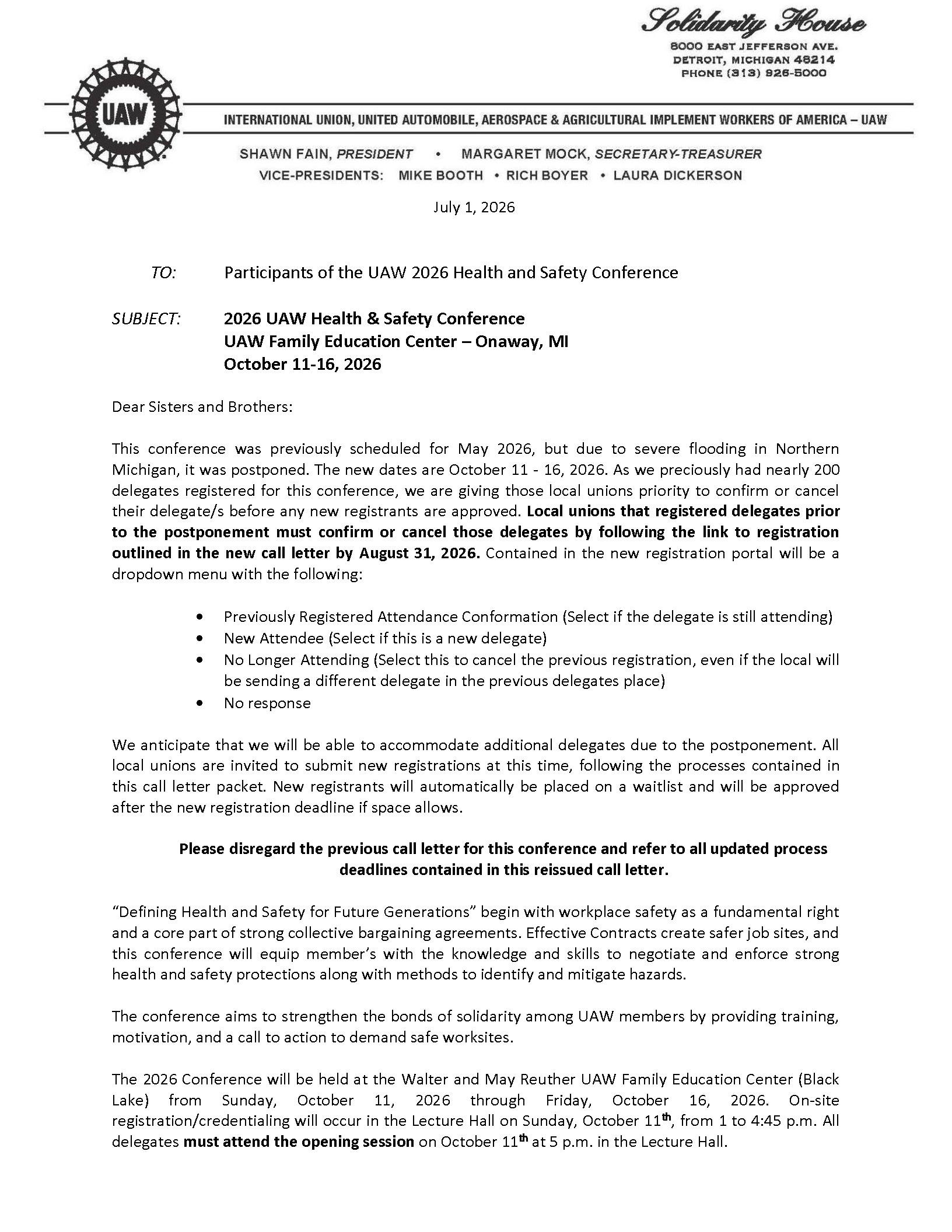
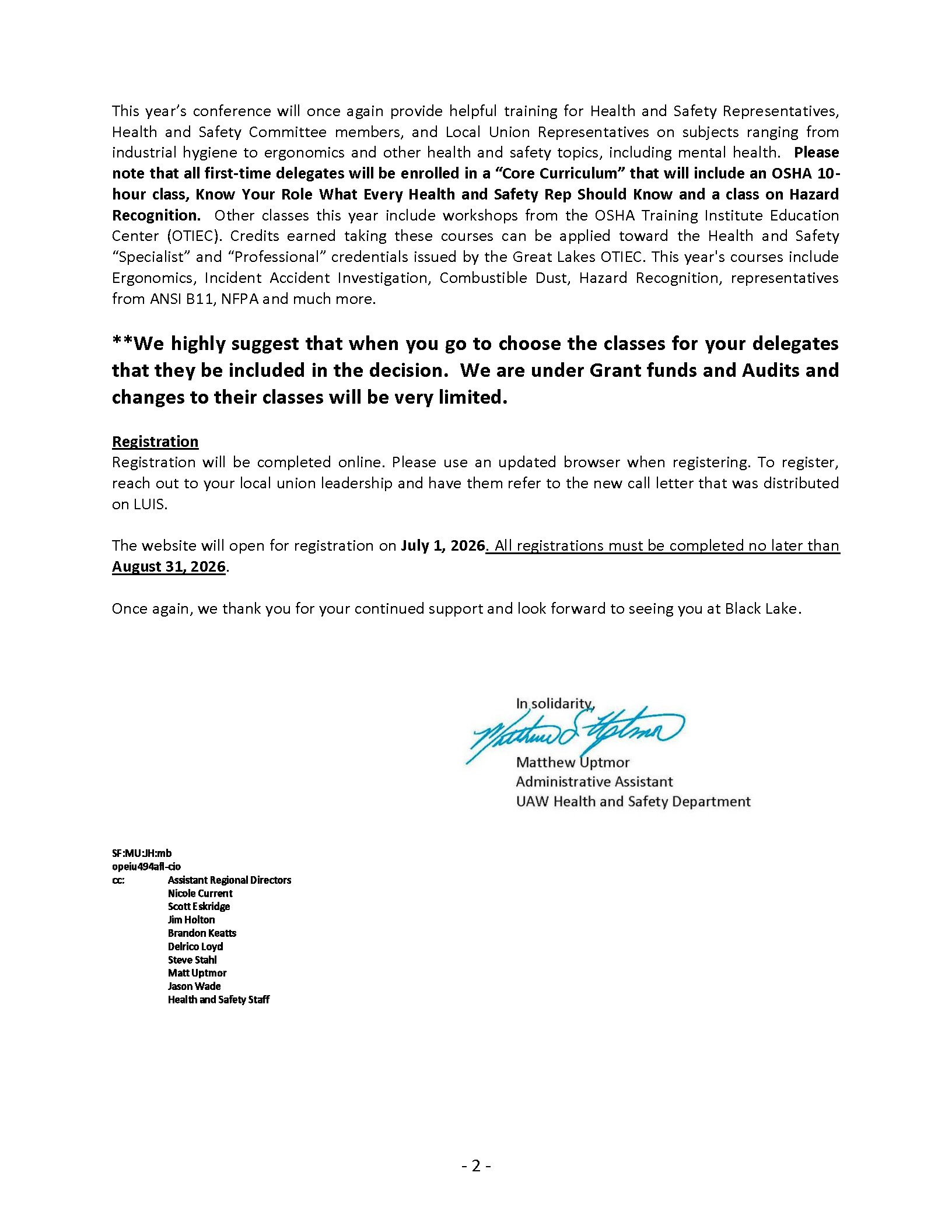
This conference was previously scheduled for May 2026, but due to severe flooding in Northern Michigan, it was postponed. The new dates are October 11 – 16, 2026. As we preciously had nearly 200 delegates registered for this conference, we are giving those local unions priority to confirm or cancel their delegate/s before any new registrants are approved. Local unions that registered delegates prior to the postponement must confirm or cancel those delegates by following the link to registration outlined in the new call letter by August 31, 2026.

Read the full letter from the UAW Health and Safety Dept. below more full details.

About 1,000 UAW Local 400 members who manufacture seats for vehicles like Ford F-150s and Stellantis Dodge RAM trucks at Bridgewater Interiors voted by 80% to ratify a new contract that secures a top rate of $35 per hour by 2030 among other major gains at the plant in Warren, MI.

“UAW Local 400 members at Bridgewater Interiors are another example of workers in the IPS sector who are ready to stand up and win their fair share,” said UAW President Shawn Fain. “They don’t treat IPS CEOs like second-class citizens. So why do they treat IPS workers that way? Whether you build axles or seats, the days of allowing IPS workers to be treated like second class citizens is ending.”

Prior to this new agreement, most workers at Bridgewater earned less than $21 per hour, with hundreds of others having been stuck under $26 per hour. The newly ratified contract raises the top rate by almost $10 per hour by May 2029 – a 36% raise in under three years. Workers also secured a cap on increases to their health care costs for the life of the agreement as well as more time off and a $2,000 ratification bonus.

“UAW Local 400 members stood united,” said UAW Region 1 Director LaShawn English. “They told the company ‘$35 by 2030’ – and because they made their voices heard, they walk away with a contract that delivers on their demand.”

This was the second tentative agreement voted on by the UAW Local 400 members, who, in addition to rejecting a previous deal by 95%, voted overwhelmingly to authorize a strike if the company did not meet their demands. This is another example of workers in IPS plants fighting to recuperate years of underwhelming wages and benefits as they generate billions for a sector that supplies the auto industry, including the Big Three. Earlier in June, UAW members at American Axle in Three Rivers, MI ratified an agreement after walking out on strike for ten days.

“After voting down an initial deal by 95% and voting to authorize a strike, UAW Local 400 members sent a clear message to Bridgewater management: no contract, no seats,” said UAW Local 400 President Mark Hemphill. “And no seats mean no trucks for Ford and Stellantis – that’s power and leverage, and we put it to work.”

Over 800 members of UAW Local 5101, representing workers at Woodward MPC, have voted by 71% to authorize a strike after months of company stall tactics and unfair labor practices during contract negotiations.

Woodward workers voted to affiliate with the UAW last fall. Since then, the company has committed over three dozen unfair labor practices, including total refusal to negotiate with the union. Workers are fighting for industry-leading wages, fair progression, time off, and job security.

On Tuesday, June 30, at 3:15pm, members will hold a practice picket outside the facility, located at 6300 W Howard St, Niles, Illinois with community allies and elected officials. Press are invited to attend.

“UAW members at Woodward have sent a clear message to the company,” said UAW President Shawn Fain. “Stop with the illegal delay tactics, bargain a fair agreement, or we’re ready to strike. Management has a choice to make: negotiate a contract, or face a strike.”

“Woodward needs to get serious about reaching a fair deal with the nearly 900 workers who make this company run,” said UAW Region 4 Director Brandon Campbell. “Local 5101 is done waiting for the company to do the right thing, and Region 4 has their backs.”

“Our membership can’t wait another 9 months for a fair contract,” said UAW Local 5101 President Jose Tapia. “Now is our time at Woodward MPC, and we are ready to do whatever it takes to win our fair share.”

The workers at Woodward build commercial and military aviation equipment for Woodward’s customers, including the U.S. Government, Boeing, and more.

Woodward has made over $1.7 billion in profits since 2020, and has paid its CEO over $30 million in that timeframe, while workers struggle to make ends meet. The more than 800 workers are members of UAW Local 5101.

Today, the UAW is celebrating the Democratic primary victory for one of the Union’s own member leaders, Claire Valdez for Congress in NY-07. UAW Region 9A mobilized thousands of members across NY-07 to help deliver a victory for New York’s working class.

“We are so proud to be sending the UAW’s own Claire Valdez to deliver for the working class in Congress,” said UAW President Shawn Fain. “We know with Claire in Congress, we’ll never ask her to pick a side in the fight for justice. This is exactly how the labor movement can fight back against corporate greed and inequality: by electing more of our own. We know Claire is ready to fight like hell in Washington for the working class and our core issues at the UAW, and we have her back.”

“We are so excited to be celebrating Claire Valdez’s Democratic primary victory today alongside a broad, multiracial, multigenerational, working-class coalition in New York,” said UAW Region 9A Director Brandon Mancilla. “For every union member we elect to office, we build a stronger, more powerful foundation to fight back against the billionaire takeover of our politics. Claire’s campaign ran on an unapologetically pro-organizing, pro-worker empowerment labor platform, and proves this is what voters are looking for right now. We’re proud of the hundreds of rank-and-file UAW volunteers that mobilized thousands of our neighbors to the polls for Claire!”

Nearly 900 delegates gathered in Detroit, Michigan, last week for the UAW’s 39th Constitutional Convention, charting an ambitious, aggressive path forward for the iconic union.

Among other business, delegates voted to grow the union’s strike fund, commit more resources to organizing, and raise strike pay, passing resolutions in support of an aggressive organizing approach and buildup to May Day 2028. The assembled delegates expanded and clarified the definition of a UAW retiree, allocated additional funding for the Women’s Department and Civil & Human Rights Departments, and added local standing committees for Communications, Health & Safety, and much more.

UAW-endorsed candidates Dr. Abdul El-Sayed and Jocelyn Benson addressed the body, as did AFL-CIO President Liz Shuler, SEIU President April Verrett, IndustriALL General Secretary Atle Hoie, Congresswoman Debbie Dingell, NAACP President and CEO Derrick Johnson, Rev. Dr. Wendell Anthony, and others. The UAW awarded the union’s prestigious Social Justice Award to four recipients: Retired UAW Vice President Chuck Browning, the workers of Volkswagen Chattanooga, the late Reverend Jesse Jackson, and Maria Medina.

The delegates elected UAW Local 838 Financial Secretary Stacie Loveless to serve as an International Trustee for a 12-year term. They also nominated candidates for the union’s International Executive Board elections, with ballots set to be mailed in August.

Elected delegates concluded business on the final day of the UAW’s 39th Constitutional Convention, as the union now moves forward with a more unified vision for the next four years.

In a jam-packed third day of the UAW’s 39th Constitutional Convention, delegates nominated candidates for this year’s International Officer elections, voted to expand the definition of what constitutes a retiree under the UAW Constitution, and elected an International Trustee. 

Day two of the 39th UAW Constitutional Convention was marked by spirited discussion on several important issues as elected delegates began shaping the union’s path forward for the next four years.