Tag Archive for: tariffs

Detroit Diesel, a manufacturer of diesel engines and axles in Detroit, has announced the addition of a third shift, the recall of laid-off workers, and the hiring of dozens more, in response to strategic tariff pressures.

In October, after months of lobbying, the federal government imposed a 25 percent tariff on heavy truck imports to prevent further offshoring and drive investment in the US heavy truck industry. The move is the latest win for UAW members in the union’s fight for reshoring and reinvesting in good union jobs.

“Strategic, targeted tariffs are an important tool in the toolbox to undo the damage of our free trade disaster and bring back good union jobs to the U.S.,” said UAW President Shawn Fain. “Companies like Detroit Diesel, and their parent company Daimler Truck North America, need to step up to reinvest in the workers who make the product and stop laying off American workers while making billions in profit. We applaud this first step in the right direction.”

“Detroit Diesel UAW members build a high-quality product that makes this company billions, and it’s only right that this company would invest right here in Michigan and recognize that success,” said UAW Region 1A Director Mark DePaoli. “We congratulate our members who are coming off of layoff and all those who will join our union with the creation of these new jobs.”

In 2025, workers from the Detroit Diesel Axle unit voted by 99 percent to ratify a new contract that won profit-sharing and cost-of-living adjustments for the first time after authorizing a strike.

In a major win for UAW members who build heavy trucks at Mack, Daimler, Navistar, Volvo, and more, the Trump administration has announced a 25 percent tariff on imported heavy trucks, after a massive grassroots lobbying campaign by UAW members and leaders.

“For decades, heavy truck makers have rushed to kill good blue-collar jobs from Allentown, Pennsylvania, to Gastonia, North Carolina, in order to pay poverty wages abroad while Wall Street makes a killing. That ends November 1st,” said UAW President Shawn Fain. “Our members lobbied and mobilized to save these communities, and made their voices heard in Washington, DC. We have pushed for action like this for decades, and we congratulate President Trump for delivering for heavy truck workers everywhere. Let’s keep going and rewrite our broken trade rules.”

A new video, Made In The Valley, tells the story of UAW Local 677 in the Lehigh Valley—how the USMCA gutted the communities that built the American heavy truck industry, and how workers fought back to save their jobs and community.

“Mack, Daimler, Navistar, Volvo — we built these companies,” said Dave Durgin, President of the UAW Bus, Engine, and Truck Council. “These executives have tried to run away from us and our families just to pay somebody $3-4 an hour to build six-figure trucks, and pocket the profits. We aren’t asking for the world. We’re saying if you want to sell your trucks in the U.S., you need to make your trucks in the U.S., at a good union wage like we’ve won at the UAW. We’re glad to see action being taken to support domestic manufacturing and good union jobs.”

The victory in the heavy truck industry is the latest blow to the so-called “free trade” system that has devastated blue collar America, from NAFTA to the USMCA. In 2026, the entire USMCA is up for review, and the UAW is pushing for a trade deal that puts the working class first.

The UAW is deeply angered by the Trump administration’s announced trade deal with Japan. What we’ve seen so far makes one thing clear: American workers are once again being left behind.

For decades, Japanese automakers have exploited open access to the U.S. market while failing to do right by American workers. Now, instead of addressing the problem, this deal gives them another break—at the expense of the very companies and workers that built the American auto industry into the global standard for good jobs and world-class products.

The UAW has pushed for well-crafted tariffs as a tool to level the playing field, bring back good jobs, and drive investment in American manufacturing. We know tariffs can work—but the execution here falls far short. Shifting timelines and moving goalposts have undermined business confidence and delayed investment. So far, only GM has stepped up with serious reshoring efforts.

Rather than building on that momentum—rewarding companies investing in union jobs—this deal hands a win to transnational automakers that rely on low-road labor practices: substandard wages, excessive temps, and union-busting.

Now, those same companies stand to benefit from lower tariffs, while unionized automakers—who could quickly create tens of thousands of good jobs using existing capacity—are left with fewer incentives to do so. Once again, American workers are being forced to suffer the consequences.

A better deal would have held Japanese automakers to the same standards U.S. workers have fought for at GM, Ford, and Stellantis: living wages, quality health care, secure retirements, job stability, and the freedom to form unions without intimidation.

If this becomes the blueprint for trade with Europe or South Korea, it will be a major missed opportunity. After decades of failed trade policy, American workers don’t need another deal that pushes them down for demanding a better life.

We need trade deals that raise standards—not reward the race to the bottom. This deal does the opposite.

General Motors announced yesterday it will invest $4 billion over the next two years across three U.S. plants in Michigan, Kansas, and Tennessee—bringing thousands of good union jobs back to the U.S.

This announcement marks a turning point in the long fight to reverse the damage caused by NAFTA and decades of so-called “free trade.” As auto tariffs help drive the return of production to the U.S., we’re beginning to undo the harm inflicted on blue-collar communities by policies that offshored jobs and gutted local economies.

By raising wages at GM globally, this shift signals the beginning of the end of the race to the bottom—where workers are forced to compete across borders over how little they can survive on, while corporations rake in billions.

“GM’s decision to invest billions in American plants and prioritize U.S. workers is exactly why we spoke up in favor of these auto tariffs,” said UAW President Shawn Fain. “The writing is on the wall: the race to the bottom is over. We have excess manufacturing capacity at our existing plants, and auto companies can easily bring good union jobs back to the U.S. They can prove the naysayers wrong by investing in our communities and putting workers before corporate greed. GM is showing that it can be done.”

The UAW has long called for an end to the unfair trade practices that allowed automakers to offshore U.S. jobs, slash wages, and shutter dozens of once-thriving plants. More than 2 million vehicles a year have disappeared from American production lines over the last decade, while factories across Mexico and low-wage regions flourished under an exploitative trade system.

“The UAW has always stood up for job security—and we are seeing results. In just the past two months, GM has announced five major investments in American auto plants. That’s no coincidence. Skilled UAW members in Michigan, Kansas, Tennessee, and beyond are the reason GM turns a profit,” said UAW Vice President Mike Booth. “It’s great to see the company reinvest in the union workforce that makes it all possible. Our members show their American Spirit and pride in building the world-class vehicles and components that keep this industry strong—right here at home.”

As the auto industry shifts its supply chains and capital investment back to the U.S., the UAW continues to push for a robust industrial policy:

  • Strong tariffs on imported vehicles and parts to stop the offshoring of jobs.
  • Renegotiation of USMCA, including enforceable labor standards and a North American minimum wage.
  • Reshoring of the auto parts supply chain to ensure American manufacturing up and down the supply chain.
  • Federal support to protect and create good auto jobs, not corporate giveaways.
  • An end to stock buybacks and profit hoarding, so auto companies reinvest in jobs, wages, and U.S. manufacturing instead of enriching executives and Wall Street’s investor class.

Today’s announcement is a clear sign that with the right trade policies and worker-led organizing, the U.S. can rebuild its auto industry to work for working-class Americans—not just Wall Street. The announcement comes on top of GM’s nearly $1 billion investment in Tonawanda Propulsion and its $579 million investment at Flint Engine Operations. The Flint commitment was secured in the union’s 2023 national contract through the membership’s historic Stand Up Strike.

“We’ll work with anyone—Democrat, Republican, or independent—who’s serious about ending the ‘free trade’ disaster and building an economy that respects working-class people,” said Fain. “But let’s be clear: tariffs without worker power just mean bigger paydays for the boss. Tariffs increase profits—but only unions increase wages. Tariffs can protect an industry. Only unions can protect workers.”

This investment is a step in the right direction—but there’s much more work to do. To truly end the race to the bottom, we need enforceable protections for workers both in the U.S. and abroad. That means real rights on the job, the freedom to assemble and organize, and strong unions across borders. Trade policy without labor rights is just corporate welfare—and we won’t settle for that.

Ending offshoring and rebuilding the auto industry also means policies that help the entire working class: a strong National Labor Relations Board, secure retirements through Social Security, guaranteed health care through Medicare and Medicaid, and dignity on and off the job. This is how we ensure today’s gains become tomorrow’s standard—not just for autoworkers, but for all working-class people.
For 40 years, we’ve seen the devastating effects of so-called “free trade” on the working class. Corporations have been driving a non-stop race to the bottom by killing good blue-collar jobs in America to go exploit some poor worker in another country by paying poverty wages. Tariffs are a powerful tool in the toolbox for undoing the injustice of anti-worker trade deals. We are glad to see an American president take aggressive action on ending the free trade disaster that has dropped like a bomb on the working class.

There’s been a lot of talk of these tariffs “disrupting” the economy. But if corporate America chooses to price-gouge the American consumer or attack the American worker because they don’t want to pay their fair share, corporate America bears the blame for that decision. The working class suffered all the pain of NAFTA, and we won’t suffer all the pain of undoing NAFTA. We want to see corporate America, from the auto industry and beyond, recommit to the working class that makes the products and generates the profits that keep this country running.

The UAW is in active negotiations with the Trump Administration about their plans to end the free trade disaster. We look forward to working with the White House to shape the auto tariffs in April to benefit the working class. We want to see serious action that will incentivize companies to change their behavior, reinvest in America, and stop cheating the American worker, the American consumer, and the American taxpayer.

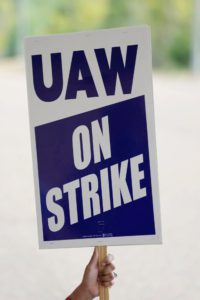
UAW On Strike SignInnovative Ideas: UI for Striking Workers
In most U.S. states, striking workers are ineligible for unemployment insurance (UI), which can weaken collective bargaining by allowing employers to engage in bad-faith tactics. Currently, only New Jersey and New York offer UI benefits to striking workers, but 13 other states are considering similar measures. Extending UI to strikers would cost between 0.04% and 0.96% of a state’s total UI expenditures, a minimal amount. Providing these benefits not only supports workers but also stabilizes local economies during strikes. Contrary to concerns, offering UI to strikers may lead to fewer strikes by promoting fair negotiations.

This article explains that extending unemployment insurance to striking workers strengthens unions and benefits the economy.

Read the full article


Podcast Statistics and Trends for 2025 (and Why They Matter)

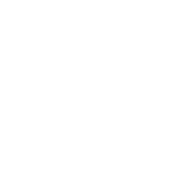
Podcasting is a great communication medium for union members, offering a direct, accessible platform to share updates, discuss labor issues, and mobilize support. It fosters engagement, strengthens solidarity, and amplifies workers’ voices beyond traditional communication channels.

This article on Riverside.fm provides key podcasting statistics for 2025, highlighting growth trends, and listener demographics. It discusses audience engagement, platform popularity, and emphasizes podcasting’s expanding influence. The piece also offers insights on content strategies and technical aspects to maximize reach.

Read the full article


UAW-Wheel-Logo

UAW Statement on Tariffs and Renegotiating U.S. Trade Agreements

President Trump has imposed a 10% tariff on Chinese goods and is currently considering additional tariff action on multiple countries, including Mexico and Canada. On February 3, the UAW made the following statement outlining our position on tariffs:

Read our full statement


UAW Members at Detroit Axle Ratify Contract

UAW members at Detroit Axle ratified a new contract with Daimler Truck, securing historic wage increases (up to 50%), profit-sharing, and COLA benefits. The victory, achieved through strong unity and strike readiness, marks a significant win for workers against corporate resistance.

This contract is a victory for labor rights and proves the power of collective action.

Watch our video


UAW Pres. Walter Reuther on Profit Sharing Plan: 1958-Part 1

In the 1950s, UAW President Walter Reuther was a visionary in advocating for profit sharing as a means to address the growing inequality between corporate profits and workers’ wages. Reuther recognized the need for workers to directly benefit from the profits they helped generate, pushing for a system that would ensure workers had a stake in the prosperity of their employers. His foresight extended beyond simple wage increases; he saw profit sharing as a way to empower workers, secure long-term economic stability, and strengthen labor rights in the face of an increasingly prosperous yet unequal economy.

Here is the first part of a two-part interview Walter Reuther had with news anchor Mike Wallace on the then “radical” plan of profit sharing.

Watch the video